Complete Guide to Taiwan Tea Making Process 2026 | The 6 Steps from Picking to Finished Product — Understanding How Great Tea Is Born
Every cup of Taiwan high-mountain oolong takes at least 2 days from picking to reaching your hands — sometimes 7 days.
During those 2 days, the tea leaves undergo a series of processes: picking, sun withering, indoor withering (with multiple rounds of stirring), rolling, fermentation, kill-green, roasting, and refining. Every step influences the final aroma and mouthfeel. One extra turn of stirring by the master, or one degree less in temperature, and the finished product becomes a different tea.
The withering and stirring processes of traditional handmade Taiwan oolong tea require the tea master to make real-time judgments based on the day’s temperature, humidity, and leaf conditions. This craft of “reading the weather and relying on experience” is the core reason why Taiwan oolong tea quality cannot be fully replicated by machines (Source: Ministry of Agriculture Tea Research and Extension Station tea craftsmanship survey, 2024).
Taiwan’s tea garden area spans approximately 16,255 hectares with an annual production of about 17,502 metric tons, of which oolong tea accounts for the largest share (Source: Ministry of Agriculture, 2024). Every metric ton of premium oolong requires meticulous processing to complete.
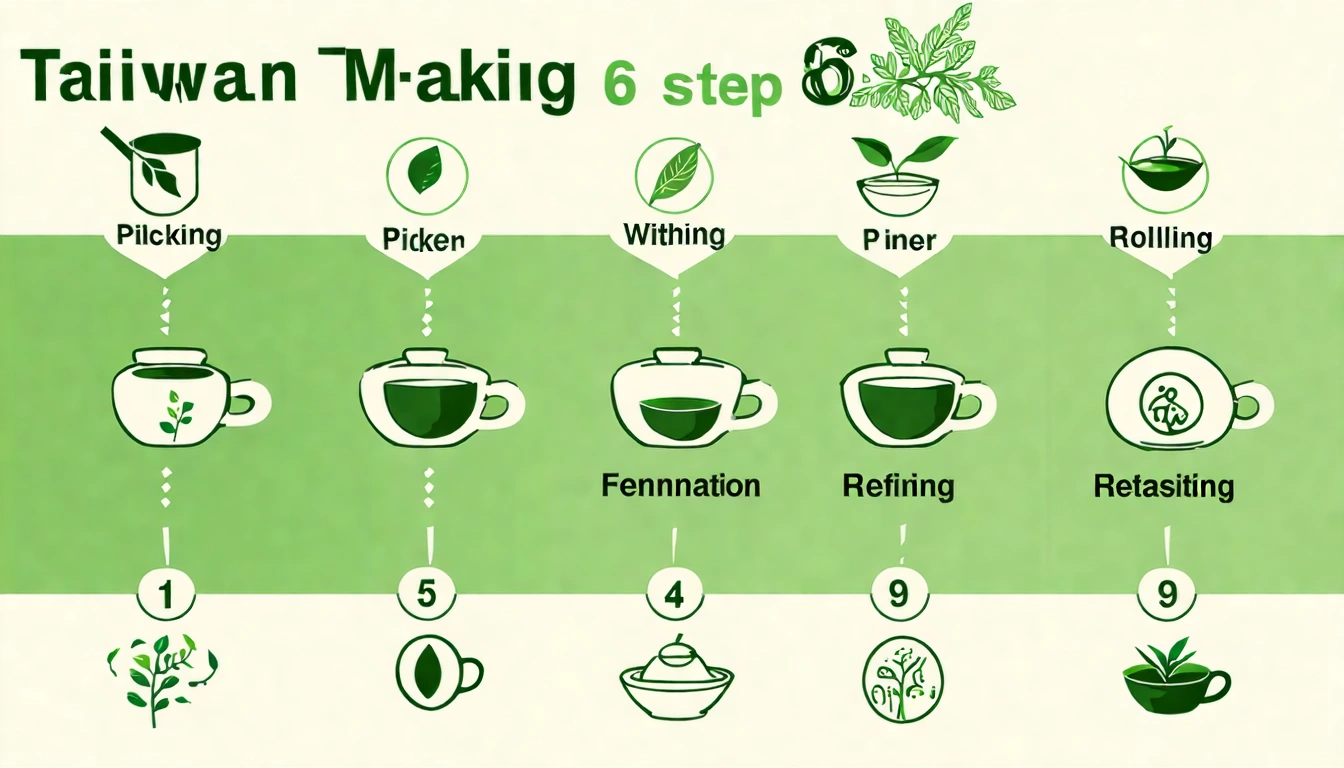
This article walks you through the 6 major steps of Taiwan tea making, clearly explaining the purpose of each. After reading, you’ll appreciate every cup of tea just a little more.
TL;DR: Taiwan oolong tea making in 6 steps: Picking → Withering → Rolling → Fermentation → Roasting → Refining. Basic production takes 1 to 2 days. The withering and stirring process depends on the master’s real-time judgment and is difficult to fully mechanize (Ministry of Agriculture, 2024). Key steps: withering and stirring determine fermentation level, roasting determines flavor profile, refining determines tea grade.
Understanding the tea-making process helps you appreciate every cup of great tea. Visit ChaYanSo
Why Is Understanding the Tea-Making Process Important?
Understanding tea making has one very practical benefit: it makes you harder to fool.
When you understand the picking conditions for high-mountain tea (small quantities, handpicked, harvested 1-2 times per year), you know why “Lishan high-mountain tea” at NT$600 per jin (600g) can’t possibly be genuine. When you know that roasting is a process requiring skill and time, you understand why truly aged roasted tea is worth the price.
Knowledge itself is a form of protection and a deeper appreciation of quality.
The 6 Steps of Taiwan Tea Making — Detailed
Step 1: Picking
Picking is the first step in tea making and one of the starting points for quality differences.
Hand picking vs Machine picking:
| Picking Method | Pros | Cons | Suitable Teas |
|---|---|---|---|
| Hand picking | Precise selection of tender buds, highest quality | High labor cost (3-5x more than machine) | High-mountain tea, competition tea, premium teas |
| Machine picking | High efficiency, low cost | Less consistent quality, higher proportion of old leaves | Lowland tea, tea bag material |
Best Picking Standard:
Authentic high-quality oolong tea requires “one bud, two leaves” (the terminal bud plus two tender leaves below). This standard ensures the tenderness of the leaves and richness of aromatic compounds. Tea made with older leaves will have a coarser mouthfeel and lack aroma complexity. Nantou County accounts for 48.9% of Taiwan’s total tea garden area, and Chiayi County for 14.1% (Source: Ministry of Agriculture, 2024) — high-mountain tea from these two major producing regions almost universally requires hand-picked one bud, two leaves.
Picking Timing:
Early morning to before noon is the optimal picking window. By this time, dew has evaporated but temperatures haven’t risen too high, so leaves remain well-hydrated and less susceptible to damage after picking. Leaves picked in high temperatures can prematurely oxidize during transport, affecting quality.
Step 2: Withering
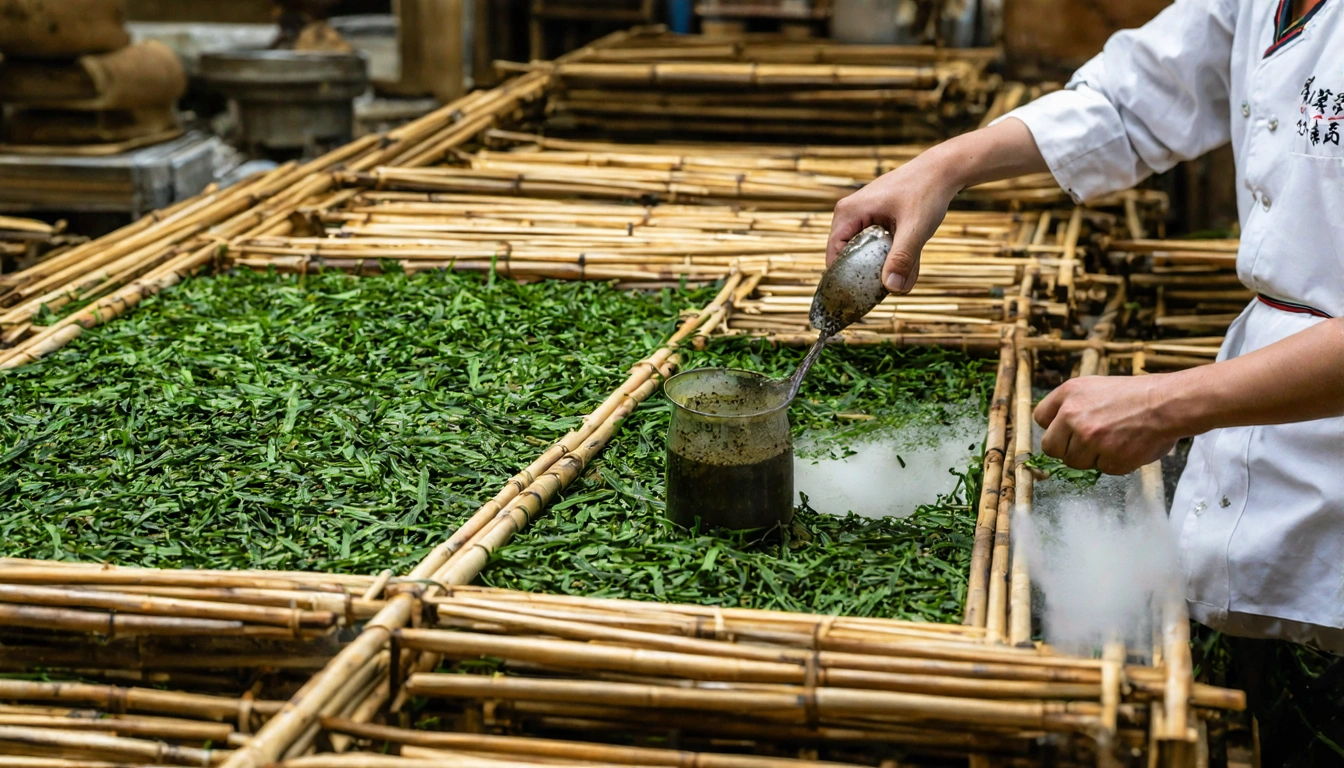
Withering allows freshly picked leaves to lose moisture appropriately and soften, preparing them for subsequent processing. Oolong tea withering is divided into “sun withering” and “indoor withering.”
Sun Withering (30 to 60 minutes):
Tea leaves are spread on bamboo trays under sunlight for initial moisture loss. Sunlight doesn’t just evaporate water — it also activates enzymes in the leaves, initiating the formation of aromatic compounds. On cloudy days when sun withering isn’t possible, modern tea factories use hot-air machines as a substitute.
Indoor Withering (6 to 12 hours):
After sun withering, leaves are moved indoors to continue withering. The key element at this stage is “stirring,” which is the most unique aspect of oolong tea production:
- Every 1 to 2 hours, the tea master gently stirs the leaves by hand (or machine)
- Stirring causes the leaf edges to bruise, promoting oxidation (fermentation)
- The force and frequency of stirring directly determine the final fermentation level
- Vigorous stirring → Higher fermentation (approaching Oriental Beauty’s heavy fermentation)
- Gentle stirring → Lower fermentation (approaching light, fragrant oolong)
Our ChaYanSo team once spent a night at a veteran Lishan tea farmer’s factory, watching him at 2 AM still keeping vigil beside the tea leaves, periodically leaning in to smell them. He said: “When the aroma shifts from grassy to honey-floral, that’s when it’s time to stop.” This kind of experience cannot be fully replaced by data. At ChaYanSo, we place special emphasis on our partner farmers’ withering control ability when selecting teas, because this single step determines 80% of the tea’s final flavor.
Step 3: Rolling
Rolling serves two purposes: breaking tea leaf cells so that the tea juices seep out, and shaping the leaves.
Ball-shaped vs Strip-shaped:
| Leaf Shape | Method | Characteristics | Representative Teas |
|---|---|---|---|
| Ball-shaped (tightly rolled) | Strong rolling followed by cloth-wrapping into balls | Durable infusions (2-3 more infusions for the same amount of tea), easy to store and transport | Most Taiwan oolong teas, Si Ji Chun, Jin Xuan |
| Strip-shaped (open) | Light rolling or no rolling | Aroma releases faster (especially fragrant in first few infusions), elegant appearance | Wenshan Baozhong Tea |
The ball-shaped rolling of Taiwan oolong tea is one of its distinguishing features, clearly different from Chinese oolong tea (mostly strip-shaped). Taiwan’s tea export unit price is approximately 6.5 times that of imported tea (Source: Ministry of Agriculture trade statistics, 2024) — Taiwan’s unique semi-ball rolling technique is an important factor behind the high export unit price. Taiwan holds over 30 tea competitions annually (Source: Ministry of Agriculture Tea Research and Extension Station, 2024), and competition teas have particularly strict rolling quality requirements.
Step 4: Fermentation (Stirring Fermentation)
Oolong tea fermentation occurs during the stirring process within withering and continues after rolling. The tea master controls time and environment to bring the leaves to the ideal fermentation level.
This step is the most “impossible to precisely quantify” part of tea making — temperature, humidity, tea cultivar, and fresh leaf quality all affect fermentation speed. The master must use their eyes, nose, and hands to make real-time judgments.
Step 5: Roasting (Kill-Green / Drying)
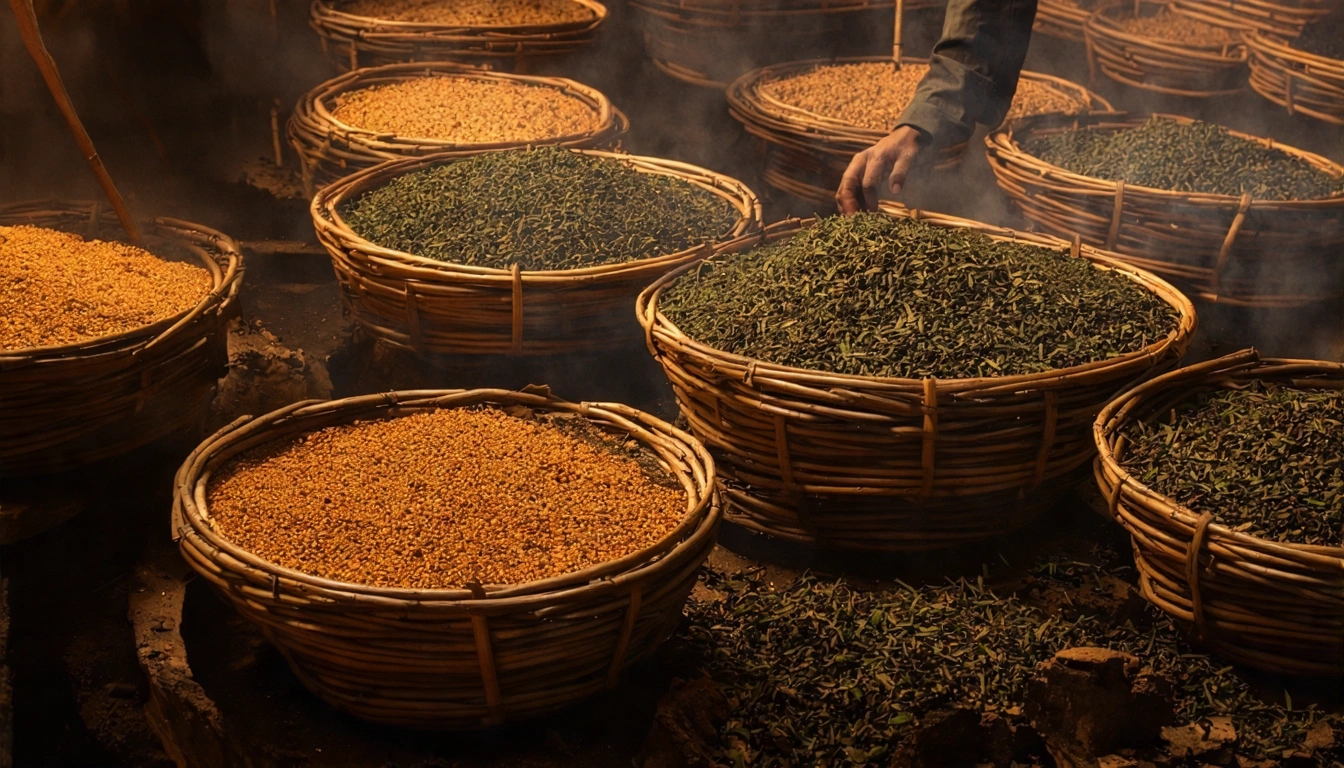
Taiwan oolong tea roasting is divided into two stages: “kill-green” (initial roasting) and “secondary roasting.” Kill-green temperature is approximately 100 to 120°C, with the purpose of rapidly stopping enzyme activity (terminating fermentation) and removing most moisture. Secondary roasting uses lower temperatures (80 to 100°C) over longer periods to develop the tea’s final flavor profile (Source: Ministry of Agriculture Tea Research and Extension Station, 2023).
Light Roast vs Heavy Roast Differences:
| Roast Level | Tea Liquor Color | Aroma Type | Mouthfeel | Shelf Life |
|---|---|---|---|---|
| Light roast (unroasted) | Pale gold | Clean floral, most preserved original aroma | Clean and sweet | Shorter (requires refrigeration) |
| Medium roast | Golden | Floral + ripe fruit coexist | Sweet and mellow | Medium |
| Heavy roast (deep roast) | Deep gold to amber | Strong roasted aroma, charcoal notes | Full-bodied and mellow | Longest (room temperature storage) |
Step 6: Refining and Packaging
Refining is the final process in tea making, ensuring the quality consistency of the finished product:
- Sorting: Removing stems, old leaves, and broken fragments by hand or machine — the sorting process for premium tea gardens is extremely time-consuming
- Grading: Sorting by leaf size and integrity
- Blending (for some teas): Mixing different batches to ensure flavor consistency
- Packaging: Nitrogen-flushed packaging (removing oxygen) extends freshness, usually with a labeled storage date
Modern Taiwan tea factories commonly employ pesticide residue testing, heavy metal testing, and other food safety measures to ensure teas meet food safety standards.
At ChaYanSo, we pay special attention to sorting quality during the refining stage. Our partner factories perform at least two rounds of sorting — one machine pass and one manual selection — ensuring every package of tea contains no stems or broken fragments. Some customers have asked why our tea brews particularly clear; a large part of the reason lies in the care taken during this refining step.
Every tea season, our ChaYanSo team visits our partner factories in Nantou and Chiayi to observe the tea-making process firsthand. Having watched tea masters keep vigil over leaves deep into the night, adjusting their stirring intensity in real-time based on the day’s weather, you come to understand why the same mountain’s leaves can produce such dramatically different quality in different masters’ hands. This is also why we insist on partnering only with experienced veteran masters.
Processing Differences Between Tea Types
| Process Step | Green Tea | Oolong Tea | Black Tea |
|---|---|---|---|
| Picking | One bud, two leaves | One bud, two to three leaves | One bud, two to three leaves |
| Withering | Light or none | Sun + indoor withering (with stirring) | Indoor withering |
| Rolling | Light to none | Medium to heavy (ball or strip) | Heavy rolling (promotes fermentation) |
| Fermentation | None (stopped by kill-green) | Partial fermentation (30-70%) | Full fermentation (80-100%) |
| Roasting | Kill-green then drying | Kill-green + secondary roasting | Drying only |
| Processing Time | 0.5-1 day | 1-2 days (plus refining) | 1-1.5 days |
Understanding tea making helps you choose truly great tea — curated by ChaYanSo. Shop Now
There’s a little-known fact about Taiwan’s tea industry: over 90% of top-tier high-mountain tea still relies on “family lineage” tea-making knowledge rather than textbooks or SOPs. A tea master with 40 years of experience has accumulated intuitive judgment from tens of thousands of observations — this knowledge is nearly impossible to fully document in writing, and it’s the true barrier that prevents Taiwan’s artisan tea from being mass-produced.
FAQ: Common Questions About Taiwan Tea Making
Can Taiwan tea factories be visited?
Some tea regions have tourism-oriented tea factories that offer reservation-based visits, providing the most direct way to understand the tea-making process. Parts of Nantou Lugu, the Alishan tea region, and New Taipei Pinglin have tea farmers and factories offering hands-on experiences. Spring and autumn tea seasons (approximately March-May and October-November) are the best times to visit — during these periods, you can witness both the picking and processing stages. We recommend contacting them in advance to confirm availability.
How long does the tea-making process take from picking to finished product?
The basic production process for Taiwan oolong tea (from picking to initial roasting completion) takes approximately 1 to 2 days. Including refining processes (sorting, secondary roasting, etc.), the complete production cycle may take 3 to 7 days. High-altitude high-mountain tea, due to low temperatures and high humidity, requires longer withering periods — sometimes a single batch needs 2 to 3 days of withering to reach the ideal state.
Can the tea-making process be fully mechanized?
Certain steps (rolling, initial roasting, sorting) can be mechanized. However, the critical withering and stirring process still relies heavily on the tea master’s on-site judgment — the same leaves require different handling under different weather conditions. This is precisely why top-tier Taiwan high-mountain tea remains difficult to fully industrialize to this day.
Further Reading
- Complete Guide to Taiwan Tea Knowledge: Six Major Tea Types and Top Ten Famous Teas
- Complete Guide to Tea Fermentation Levels: The Science from Green Tea to Black Tea
- Spring Tea vs Winter Tea Complete Comparison: How the Same Tea Differs Across Seasons
- Alishan Tea Complete Guide: High-Mountain Tea Picking Environment and Quality Features
- Beginner’s Guide to Buying Taiwan Tea: Understanding Tea Making to Shop Smarter
References
- Ministry of Agriculture Tea Research and Extension Station (2024). Taiwan Tea Craftsmanship Technology Survey Report.
- Ministry of Agriculture Tea Research and Extension Station (2023). Taiwan Oolong Tea Making Technology Guide.