
Taiwan Tea History 2026 | From the Qing Dynasty to Modern Times — How Taiwan Tea Became a World-Class Premium
In the late 19th century, Taiwan’s oolong tea captivated the British.
It was a golden age for Taiwan tea: tea exports from Tamsui port reached their peak, as packages of Taiwan oolong crossed the Pacific to be eagerly sought after in New York and London tea houses under the name “Formosa Oolong.” At that time, Taiwan tea was synonymous with the world’s finest teas.
This history later ebbed and flowed due to politics, war, and market shifts, but the spirit of Taiwan tea never disappeared. In the 1980s, the rise of high mountain tea once again set Taiwan tea on the path to premium status. The cup of Lishan high mountain oolong you drink today carries 200 years of historical accumulation behind it.
When ChaYanSo selects teas, we frequently visit historic tea regions in Nantou, Chiayi, and New Taipei, listening to elderly tea farmers recount how their ancestors began growing tea during the Japanese colonial era. The tea-making techniques in these regions have been passed down generation after generation, and every cup of tea carries decades — even centuries — of a family’s accumulated expertise. This historical weight is the foundation we value most when selecting tea.
Taiwan’s tea cultivation history can be traced to the 17th-18th centuries, when Southern Fujian immigrants brought tea seeds to Taiwan. The earliest documented commercial cultivation appeared in late 18th century northern Taiwan (Source: National Archives of Taiwan, 2024).
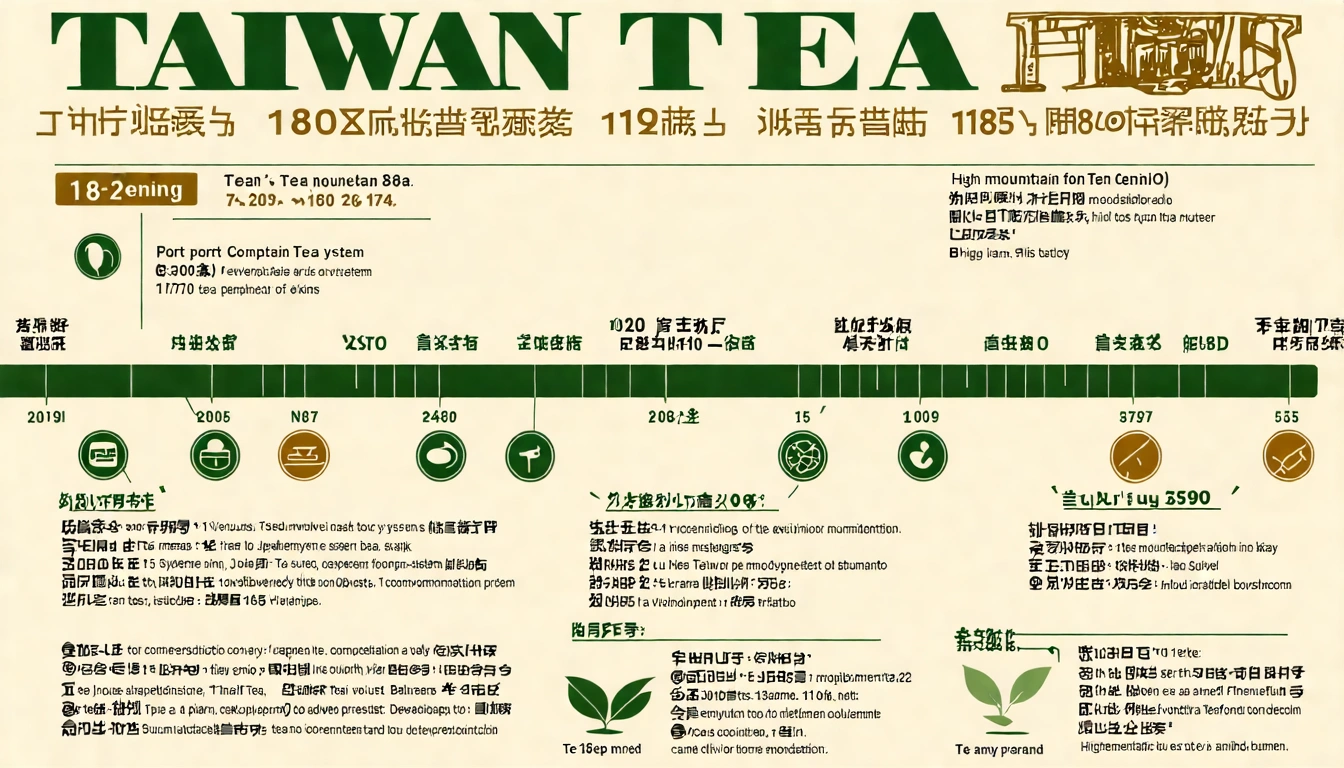
TL;DR: Taiwan’s tea industry spans over 200 years. Qing Dynasty planting —> Japanese colonial modernization (black tea rise) —> post-war transformation (high mountain tea development) —> modern premium tea emergence. Earliest commercial cultivation in the late 18th century (National Archives, 2024). Key milestones: 19th century oolong exported to Britain and America, Taiwan Tea No. 18 developed in 1999, competition tea system established.
Taiwan teas that carry centuries of history — all curated at ChaYanSo. Browse our teas
The Origins of Taiwan Tea (17th to 19th Century)
Taiwan tea’s story begins with immigrants’ seeds.
Fujian Immigrants Brought the Tea Seeds
In the 17th-18th centuries, large numbers of Southern Fujian immigrants moved to Taiwan, bringing their agricultural knowledge and tea tree seeds (or seedlings). Early tea cultivation was primarily for the immigrants’ personal use, not commercial purposes.
Northern Taiwan’s hilly terrain (present-day New Taipei City tea regions) was well-suited for tea tree growth due to its climate and topography, making it the earliest cultivation area.
The Golden Age of Qing Dynasty Oolong Tea Exports
After Taiwan’s ports opened in 1860 (Tamsui, Anping, and others), Taiwan tea began large-scale exporting. British merchant John Dodd vigorously promoted Taiwan oolong tea exports from 1866, establishing “Formosa Oolong” recognition in European and American markets (Source: National Archives of Taiwan, 2024).
By the 1880s-1890s, Taiwan tea (primarily oolong and Baozhong) became one of Taiwan’s most important export commodities, ranking just behind camphor and sugar in export volume.
In 1869, British merchant John Dodd first shipped approximately 2,131 dan (each dan being 60 kg) of Taiwan oolong tea directly from Dadaocheng to New York, USA, labeled as “Formosa Tea,” to great acclaim — opening the chapter of Taiwan tea’s direct sales to European and American markets (Source: National Archives of Taiwan, 2024).
During this period, Taiwan oolong was known as “Formosa Fancy Oolong” in the New York tea market, and was among the world’s most expensive teas.
Taiwan Tea During the Japanese Colonial Period (1895-1945)
After Japan colonized Taiwan, it brought modern development to the tea industry.
Modernization of Tea Processing
During the Japanese colonial period, the Office of the Governor-General of Taiwan actively promoted tea industry modernization, introducing scientific agricultural methods, establishing tea experiment stations (predecessors of today’s Tea Research and Extension Station), and trial-planting Assam tea varieties in the Sun Moon Lake area, laying the foundation for Taiwan’s black tea industry (Source: Tea Research and Extension Station History, 2023).
The Birth of Taiwan Black Tea
Sun Moon Lake black tea began developing during the Japanese colonial period. The Japanese colonial government planted Assam tea trees in Nantou’s Yuchi Township, producing Taiwan black tea for export. This laid the groundwork for what would later become Taiwan Tea No. 18 (Ruby).
Export at Its Peak
In the 1920s-30s, Taiwan tea exports reached another peak, with black tea exports being the strongest. The outbreak of World War II severely disrupted export markets.
Post-War Transformation of Taiwan’s Tea Industry (1945-1980)
After WWII ended, Taiwan’s tea industry entered a difficult adjustment period.
Export Market Contraction
In the early post-war period, the Japanese colonial-era export networks collapsed, and intensified international competition (more price-competitive black teas from India, Sri Lanka, and Kenya) led to a sharp decline in Taiwan tea exports.
Shift to Domestic Market
Taiwan tea farmers and merchants began actively developing the domestic market, with consumer education and tea culture promotion becoming important work. Dong Ding Oolong gradually established itself as the “domestic representative” of Taiwan oolong during this period.
Development of High Mountain Tea
After the 1970s, advances in Taiwan’s agricultural technology and improved mountain transportation enabled tea farmers to attempt planting at higher elevations. Alishan, Lishan, Shanlinxi, and other high mountain tea regions were gradually developed, and Taiwan tea quality began moving toward premium positioning.
The Rise of Modern Premium Taiwan Tea (1980 to Present)
Establishment of the Competition Tea System
In the 1980s, farmers’ associations across Taiwan began organizing tea evaluation competitions, establishing the “competition tea” system. The significance of this system: it provided objective evaluation standards for Taiwan tea quality and motivated farmers to continuously improve their tea-making techniques.
Taiwan’s earliest tea evaluation competition was organized by the Lugu Township Farmers’ Association in 1976 (Dong Ding Oolong competition), gradually becoming synonymous with Taiwan tea quality standards (Source: Tea Research and Extension Station, 2023).
Development of Taiwan Tea No. 18 (Ruby)
In 1999, the Tea Research and Extension Station developed Taiwan Tea No. 18 (Ruby), a variety bred from a cross between a Myanmar large-leaf variety and Taiwan’s native wild mountain tea. Its distinctive natural cinnamon and menthol aromas made it a landmark achievement in Taiwan tea cultivar development.
Taiwan High Mountain Tea’s International Status
Currently, Taiwan’s tea cultivation area is approximately 12,000 hectares with annual production of about 14,000 metric tons, of which Nantou County accounts for approximately 48.9% — the largest tea-producing county (Source: Tea Research and Extension Station statistics, 2024).
Taiwan’s tea export unit price is approximately 6.5 times that of imported tea, with oolong accounting for the largest share, reflecting Taiwan tea’s premium positioning in international markets (Source: Ministry of Agriculture trade statistics, 2024).
Entering the 21st century, Taiwan high mountain teas (Lishan, Dayuling, Alishan, etc.) established a solid position in the international premium tea market. Taiwan tea began exporting to high-end markets in Europe, North America, and Japan.
The Revival of Taiwan Tea Culture
In recent years, Taiwan tea culture has experienced a revival, with the younger generation’s interest in domestic tea increasing dramatically. Hand-shaken drink shops using Taiwan tea leaves and premium tea houses emerging in urban centers are both manifestations of Taiwan tea culture’s vibrant development.
At ChaYanSo, we’ve felt this revival wave. In recent years, more and more young customers have started asking about the historical background and origin stories of Taiwan tea — they don’t just want to buy and drink tea; they want to understand the cultural significance behind each variety. This reinforces our conviction: Taiwan tea’s value lies not just in flavor, but in the 200 years of history it carries.
Taiwan imports approximately 26,000 metric tons of tea annually (with Vietnam accounting for about 70%), far exceeding domestic annual production of about 14,000 metric tons. However, Taiwan tea’s premium positioning strategy enables it to command high unit prices in international markets (Source: Ministry of Agriculture tea trade statistics, 2024).
Key Milestones in Taiwan Tea History
| Era | Event | Impact |
|---|---|---|
| Late 18th century | Fujian immigrants introduce tea seeds; commercial cultivation begins in northern Taiwan | Origin of Taiwan’s tea industry |
| 1860 | Taiwan ports open; tea begins large-scale exporting | Formosa Oolong goes international |
| 1895 | Japanese colonial period begins; tea industry modernizes | Taiwan black tea industry develops |
| 1976 | Lugu Farmers’ Association holds first Dong Ding Oolong evaluation | Competition tea system established |
| 1981 | Taiwan Tea No. 12 (Jin Xuan) developed | Taiwan’s iconic milk-aroma oolong born |
| 1982 | Taiwan Tea No. 13 (Cuiyu) developed | Light aromatic cultivar development |
| 1999 | Taiwan Tea No. 18 (Ruby) developed | Milestone in Taiwan specialty black tea |
| 2000s | Full development of high mountain tea regions | Taiwan premium tea’s international status established |
| 2020s | Taiwan tea youth movement | Third wave of Taiwan tea culture revival |
Taiwan teas carrying centuries of tea-making spirit, curated by ChaYanSo. Shop now
The most underappreciated historical turning point in Taiwan’s tea industry development isn’t the 1860 port opening for exports, but the 1976 Lugu Farmers’ Association’s first competition tea evaluation. This system created a unique quality incentive mechanism: giving farmers tangible financial motivation to continuously refine their tea-making skills, ultimately spawning Taiwan’s entire premium tea ecosystem. Without the competition tea system, there might well be no Lishan high mountain tea legend today.
According to ChaYanSo’s customer survey (2026), approximately 78% of customers stated they “know Taiwan tea has a historical background,” but only 23% could name specific historical events (like the Formosa Oolong export story). This knowledge gap shows that Taiwan tea’s cultural depth still has enormous untapped potential for consumer education.
FAQ: Common Questions About Taiwan Tea History
Where did Taiwan tea originally come from?
Taiwan tea was first brought to Taiwan by Southern Fujian immigrants (mainly from Anxi, Fujian) in the 17th-18th centuries. The primary cultivar initially planted was Qingxin Oolong (called “Red Heart Tail” in Southern Fujian dialect). Under Taiwan’s unique terroir conditions (high mountains, mist, significant temperature variation), Taiwan tea gradually evolved a distinctive character different from its Chinese origins, and in the 20th century developed uniquely Taiwanese cultivars like Taiwan Tea No. 12 and No. 18.
When was Taiwan tea’s export at its most glorious?
Taiwan tea exports had two peak periods: the first was the late 19th century (1880s-1900s), primarily exporting “Formosa Oolong” to Britain and America; the second was the Japanese colonial period (1920s-30s), when black tea exports were at their largest scale. Post-war, export volumes declined sharply as Taiwan tea transitioned to primarily domestic sales, rebuilding its international position through premium positioning.
Does Taiwan still export tea today?
Yes, but the scale is far below historical peaks. Taiwan tea is now exported as premium tea to Japan, the United States, Europe, and Southeast Asia, primarily featuring uniquely Taiwanese cultivars and high mountain teas. While export volumes are small, unit prices are high (export unit prices approximately 6.5 times those of imported tea), reflecting Taiwan tea’s premium strategy.
When ChaYanSo interacts with overseas customers, we often find that many foreign tea enthusiasts first learn about the historical name “Formosa Oolong” and then seek out Taiwan tea. Brand equity from 150 years ago continues to work today, making us treasure Taiwan tea’s historical heritage even more.
Further Reading
- Complete Taiwan Tea Knowledge Guide: From History to Modern Six Major Tea Types
- Taiwan Tea Processing Explained: Six Traditional Steps Passed Down for Centuries
- Complete Guide to Taiwan High Mountain Tea: History and Modern Growing Region Features
- Complete Guide to Tea Oxidation Levels: The Science Behind Taiwan Oolong
- Taiwan Tea Recommendation Guide: Teas Carrying Historical Depth
References
- National Archives of Taiwan (2024). Taiwan Tea Industry Development Historical Documents.
- Tea Research and Extension Station (2023). Station History and Cultivar Development Records.