
Complete Introduction to Taiwan Tea Culture 2026 | From Tea History to Modern Tea Ceremony
A single cup of Taiwan high mountain oolong tea carries over 200 years of tea-growing history, spanning the Qing Dynasty, Japanese colonial period, post-war era, and modern times, along with the dedication of countless Taiwan tea farmers to preserving their craft. According to the Ministry of Agriculture statistics, Taiwan’s tea cultivation area in 2022 was 12,192 hectares with an annual output of approximately 14,027 metric tons, of which oolong tea (semi-oxidized tea) accounts for the largest share. Drinking Taiwan tea isn’t just having a beverage — you’re tasting the terroir stories of this land and the accumulated tea artistry of several generations.
TL;DR
Taiwan’s tea industry originated during the Qing Dynasty’s Qianlong era (approximately the 1770s). After the opening of Tamsui port in the 1860s, tea rapidly commercialized and became one of Taiwan’s most important export commodities. During the Japanese colonial period (1895-1945), Taiwan’s tea industry modernized with the establishment of modern tea processing factories. In the 1970s, high mountain tea emerged, forming the core competitiveness of today’s Taiwan tea. Oriental Beauty Tea reportedly gained international fame after Queen Victoria of England tasted and named it.
The History of Taiwan Tea: Over 200 Years of Tea Industry Legend
The Qing Dynasty Period (1770s-1895): Origins of Taiwan’s Tea Industry
Taiwan’s tea-growing history traces back to the mid-18th century. During the Qianlong era of the Qing Dynasty, Fujian immigrants brought tea seedlings to Taiwan and began planting in the areas surrounding the Taipei Basin (present-day Wenshan, Pinglin, and Sanxia). The earliest Taiwan teas were primarily “Baozhong tea,” exported through Qing Dynasty maritime trade routes.
The 1860s were a pivotal turning point for Taiwan’s tea industry. After the opening of Tamsui and Anping ports, foreign trading houses entered the Taiwan tea trade. The large-scale purchasing by British and American merchants, in particular, rapidly brought Taiwan tea to the international market. In 1869, Taiwan tea was exported directly to the United States for the first time, opening Taiwan tea’s international stage.
By the 1880s-1890s, Taiwan tea had become a globally significant tea supplier. Oolong tea in particular enjoyed great renown in European and American markets, with recognition that surpassed even today’s. At its peak during the late Qing period, Taiwan tea exports accounted for over 50% of Taiwan’s total export value.
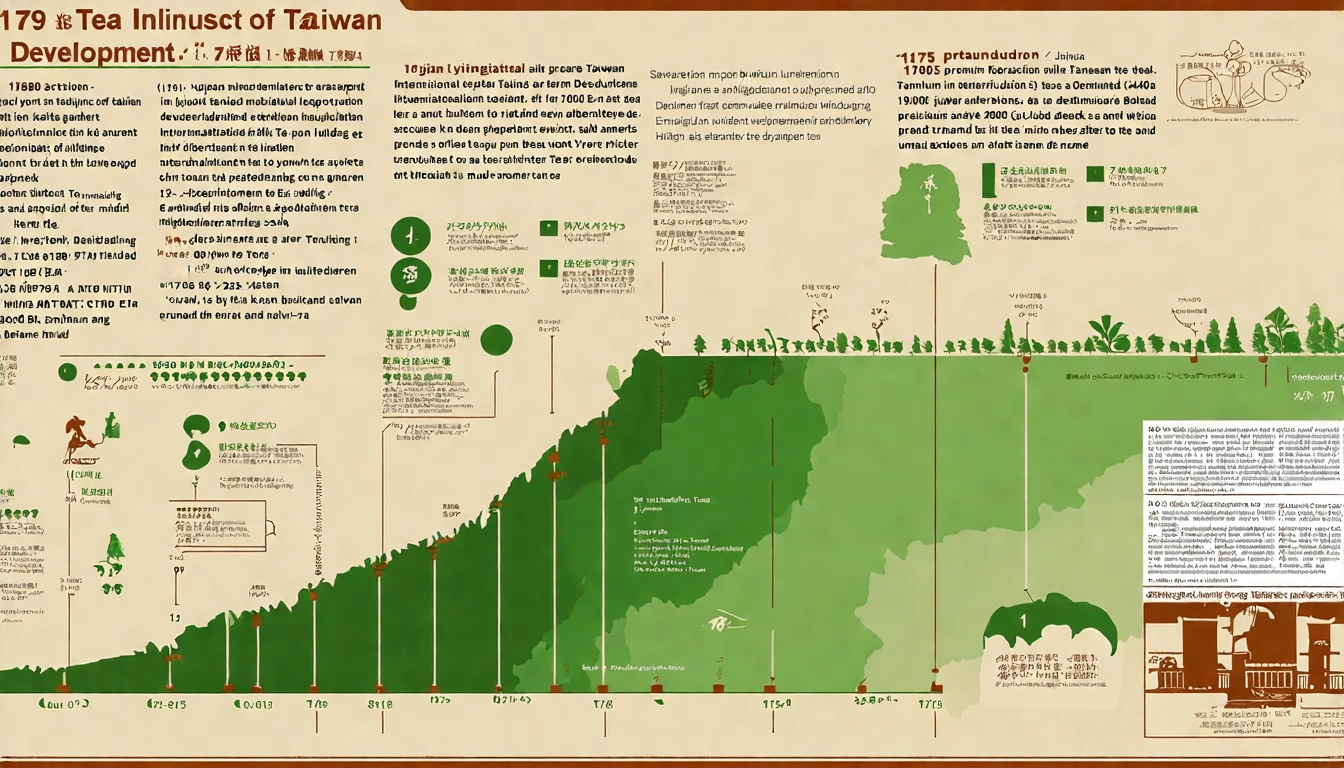
Japanese Colonial Period (1895-1945): Modernization and Cultivar Innovation
After Japan colonized Taiwan, the tea industry underwent systematic modernization. In 1903, the Office of the Governor-General of Taiwan established the “Anping Tea Experiment Station” (predecessor of today’s Tea Research and Extension Station), beginning systematic research into Taiwan tea cultivar development and processing technique improvements.
Key developments during the Japanese colonial period:
- Introduction of black tea production: In the 1920s, the Japanese planted Assam tea trees in the Sun Moon Lake area, giving birth to Taiwan black tea
- Establishment of modern tea factories: Modern processing factories made Taiwan tea quality more consistent and expanded production scale
- Export market expansion: During the Japanese period, Taiwan tea’s primary markets were mainland Japan and Southeast Asia, further expanding the geographic reach of tea sales
- Cultivar research: Japanese agricultural scientists began systematically documenting Taiwan’s wild tea tree varieties, laying the foundation for future cultivar development
1945-1970s: Post-War Rebuilding and Lowland Tea Cultivation
In the early post-war period, Taiwan’s tea industry faced market reconstruction. The Japanese colonial-era export networks were reorganized, and Taiwan tea sought new export destinations, with British, American, and Middle Eastern markets becoming important new sales channels.
During this period, Taiwan’s tea industry was primarily concentrated in lowland tea regions — the Wenshan tea areas of Taoyuan-Hsinchu-Miaoli, northern Pinglin, and Nantou lowlands. To this day, Nantou County remains Taiwan’s largest tea-producing region, with cultivation area accounting for 48.9% of the national total, followed by Chiayi County (14.1%).
1970s-1990s: The Rise of High Mountain Tea, Taiwan Tea’s Critical Transformation
The 1970s were the most important transformation period for Taiwan’s tea industry. Two factors together drove the rise of high mountain tea:
First, road construction opened up the mountains: The construction of the Cross-Island Highway, Alishan Highway, and other mountain roads made agricultural development at high elevations (above 1,000 meters) possible. Previously inaccessible areas like Lishan, Shanlinxi, and Alishan gradually saw tea farmers venturing uphill to plant tea.
Second, consumer markets pursued quality: Taiwan’s rapid economic development gave consumers the means to pay for higher-quality tea. High mountain tea’s sweet flavor and healthy image perfectly matched this market demand.
In the 1980s, Taiwan’s Tea Research and Extension Station developed new cultivars including “Jin Xuan (Taiwan Tea No. 12)” and “Cuiyu (Taiwan Tea No. 13).” These varieties with distinctive natural aromas (Jin Xuan’s milk fragrance, Cuiyu’s jade orchid fragrance) significantly expanded Taiwan tea’s diversity.
Taiwan’s Famous Teas on the World Stage
Oriental Beauty Tea: The Legend of Queen Victoria’s Naming
Oriental Beauty Tea (also known as Bai Hao Oolong/White Tip Oolong) has a widely told story in Taiwan: reportedly in the late 19th century, this uniquely Taiwanese heavily oxidized oolong tea was brought to England, where Queen Victoria tasted it and was so impressed by its distinctive honey-fruit aroma that she called it “Oriental Beauty” — a name that has persisted to this day.
While the specific historical record of the queen’s naming is debated, Oriental Beauty Tea did indeed enjoy very high acclaim in the European tea market of the late 19th century.
What makes Oriental Beauty Tea unique is its insect-bite oxidation process — after leafhoppers bite the tea leaves, the leaves activate their defense mechanism, producing a distinctive honey-fruit aroma. This natural process can only be completed under the specific climatic conditions of Hsinchu and Miaoli, making it a uniquely Taiwanese tea that cannot be replicated elsewhere.
Taiwan High Mountain Oolong’s International Status
Taiwan’s Alishan and Lishan high mountain oolong teas enjoy high acclaim in the international premium tea market. Each year at Taiwan’s “Premium Tea Competitions,” top-tier teas from various regions can fetch prices of tens of thousands of NT dollars per jin (600g), attracting tea enthusiasts from Japan, Hong Kong, and Southeast Asia to bid.
Between 2024-2025, Taiwan tea continued to receive high marks in multiple international tea evaluations, with Alishan oolong and Oriental Beauty Tea in particular seeing increasing visibility in the European premium tea market.
Taiwan Tea Ceremony Culture: From Gongfu Tea to Modern Tea Appreciation
The Taiwan Heritage of Gongfu Tea
Taiwan’s tea appreciation culture is deeply influenced by the Southern Fujian gongfu tea tradition. Gongfu tea (kung fu tea) uses small pots and small cups, emphasizing precision in brewing procedures — water temperature, tea quantity, and steeping time all require careful attention. This pursuit of excellence in tea appreciation continues today in Taiwan’s tea house culture and tea master training.
Characteristics of Taiwan-style Gongfu Tea:
- Uses Yixing clay teapots or gaiwans (covered cups)
- Tea set arrangement has aesthetic requirements
- Emphasizes the evolution of tea aroma (first infusion for aroma, second for sweetness, third for hui gan)
- Practices the “pour high, serve low” pouring technique
The New Style of Modern Taiwan Tea Ceremony
Contemporary young Taiwanese have developed a more relaxed, everyday style of tea appreciation — not necessarily requiring a full tea set or strict ceremony, just finding a moment in daily life to enjoy a good cup of tea.
The spread of this “light tea ceremony” is actually a positive development of Taiwan tea culture further entering everyday life. From the refined experience of high-end tea houses to simply brewing a cup of Alishan light oolong with a tea bag at the office, both are organic extensions of Taiwan’s tea ceremony in modern society.
The Evolution of Tea House Culture
The bubble tea culture that emerged in Taiwan during the 1980s-1990s was actually an important milestone in the modernization of Taiwan tea culture — transforming tea from “something old people drink” into a daily beverage choice for young people. Although hand-shaken drinks later replaced bubble tea’s mainstream position, this cultural shift made Taiwan one of the world’s most vibrant tea beverage markets — Taiwan consumes over 32,000 metric tons of tea annually, about 80% of which is imported. Taiwan’s domestically produced tea, on the other hand, positions itself as premium, with export unit prices approximately 5-6.5 times those of imported tea.
Taiwan Tea’s Modernization and Brand Innovation
The Branding Trend of Premium Taiwan Tea
Since the 2010s, Taiwan’s tea industry has shown a clear branding trend. Unlike the previous model of farmers or wholesalers selling loose tea, more and more brands are investing in:
- Building brand stories: Helping consumers know the farmers and understand the origins
- Improving packaging design: From plastic bags to refined gift boxes, Taiwan tea’s packaging quality has improved dramatically
- Online direct-to-consumer channels: Using e-commerce and social media to reach consumers directly, eliminating middlemen
- International market development: Some Taiwan tea brands are actively developing premium tea markets in Japan, Europe, and the Americas
The Younger Generation’s Reinterpretation of Taiwan Tea
Today’s young Taiwan tea artisans inherit the spirit of gongfu tea craftsmanship while bringing in modern aesthetics — with minimalist teaware, natural-style packaging, and Instagram sharing culture, they’ve brought Taiwan tea to a younger consumer demographic.
This generation of tea artisans also places greater emphasis on sustainable agriculture and fair returns for tea farmers. Choosing organically certified, direct-trade Taiwan tea has become an expression of consumer values.
ChaYanSo was born in this era — connecting local Taiwan tea farmers and helping consumers discover Taiwan tea’s stories through every box of tea. We’ve visited major growing regions including Alishan, Shanlinxi, and Lishan, witnessing firsthand how the younger generation of tea farmers uses modern thinking to carry forward centuries-old craftsmanship. This inspiration drives us to continue doing our best with every tea. Learn more about our brand philosophy at Taiwan Tea Brand Complete Review.
Taste the essence of 200 years of Taiwan tea artistry — ChaYanSo curates the finest local Taiwan teas. Browse our teas
FAQ
Q: When did Taiwan start growing tea?
Taiwan’s tea-growing history began during the Qing Dynasty’s Qianlong era (approximately the 1770s), when Fujian immigrants brought tea seedlings to northern Taiwan. After the opening of Tamsui port in the 1860s, Taiwan tea began large-scale exporting. In 1869, the first direct export to the United States opened Taiwan tea’s international stage. At its peak during the late Qing period, Taiwan tea exports accounted for over 50% of Taiwan’s total export value, making it the most important agricultural export at the time.
Q: How did Oriental Beauty Tea get its name?
Oriental Beauty Tea (Bai Hao Oolong) is said to have been brought to England in the late 19th century. After Queen Victoria tasted it and was greatly impressed, she reportedly called it “Oriental Beauty,” and this English name has been used in international tea markets ever since.
Q: What achievements has Taiwan tea made on the world stage?
Taiwan has several world-class achievements in the oolong tea category: Oriental Beauty Tea was appreciated by British royalty in the 19th century; Taiwan Tea No. 18 (Ruby) was listed as a premium tea by Britain’s top tea merchant Fortnum & Mason; Alishan and Lishan high mountain oolongs consistently win international tea competitions; and Taiwan’s “Premium Tea Competitions” attract tea enthusiasts from Japan, Hong Kong, and Europe each year to bid on top-tier lots.
Q: How is Taiwan gongfu tea different from Chinese gongfu tea?
Taiwan’s gongfu tea inherits its brewing techniques from Southern Fujian gongfu tea (Chaoshan gongfu tea), sharing the same basic philosophy of small pots and cups with careful temperature control. However, Taiwan’s gongfu tea is more commonly paired with local Taiwan oolong varieties (Dong Ding Oolong, Alishan, etc.), and in cultural development, it has integrated Taiwan’s local lifestyle aesthetics, forming a distinctive “Taiwan tea ceremony” style.
Taiwan Tea Culture: From Historical Stories to Modern Appreciation — 200 Years in Every Cup
Over 200 years of tea-growing history, from Qing Dynasty immigrants’ tea seedlings to modern premium tea brands — Taiwan tea has weathered many historical turning points while maintaining its commitment to quality and respect for terroir. The sweetness in every cup of Alishan high mountain oolong is a gift from this land and its tea farmers to all of us.
To learn about Taiwan’s tea-growing regions, see Complete Guide to Taiwan Tea Regions; to find the Taiwan tea best suited to you, see Complete Taiwan Tea Recommendation Guide; to compare Taiwan tea brands, see Taiwan Tea Brand Ranking Review.
Taiwan tea carries the most beautiful memories of this land — ChaYanSo is here to help you experience them. Explore ChaYanSo
Further Reading
- Complete Taiwan Tea Recommendation Guide: From Varieties to Brewing
- Complete Guide to Taiwan Tea Regions: Origins, Flavors, and Buying Guide
- Taiwan Tea Brand Review: Origin-Direct vs. Distributor Brands
- Taiwan Tea vs. Japan Tea vs. China Tea: Complete Three-Way Comparison
- Taiwan Tea Online Shopping Guide: How to Buy Authentic Taiwan Tea with Confidence