
Understanding Tea Grades 2026 Complete Guide | Competition Tea, Special Grade, and First Grade Explained
You see “Special Grade Award” on a tea shop label and assume it must be the best. Then you notice another tea labeled “First Grade Award” — at a higher price.
Now you’re confused.
Taiwan’s tea grading system isn’t immediately intuitive because it’s the product of a competition system with its own logic. Once you understand it, you can use grade information to make better tea-buying decisions — rather than impulsively purchasing anything labeled “Special Grade.”
Taiwan holds over 30 tea competitions annually, organized separately by county and city farmers’ associations, agricultural improvement stations, and the Tea Research and Extension Station, making it one of the most intensive tea evaluation systems in the world (Source: Ministry of Agriculture, Tea Research and Extension Station, 2024).
TL;DR: Taiwan tea competition grades: Special Grade (highest, top 1-3) → First Grade (second tier) → Superior Grade (third tier) → Standard Grade (fourth tier). Over 30 tea competitions held annually nationwide (Ministry of Agriculture, 2024). Competition tea is worth buying, but no award does not equal poor quality; for organic certification, look for TOPA or TOAF labels.
Understand grades before buying tea — ChaYanSo curates quality across all grades. Browse our teas
How Does Taiwan’s Tea Grading System Work?
Taiwan’s tea grading isn’t a simple quality scoring system — it’s the result of competition evaluations. Understanding this system requires knowing “who runs the competitions” and “how scoring works.”
Competition organizers
Taiwan tea competitions are organized by:
- County and city farmers’ associations: Such as Lugu Township Farmers’ Association (Dong Ding Oolong competition), Mingjian Township Farmers’ Association (Songbozhangqing Tea competition), etc.
- Agricultural improvement stations: Provide technical evaluation support
- Tea Research and Extension Station: Organizes specific varietal or national competitions
These competitions are independently run with their own judging standards, so the same “Special Grade Award” from different farmers’ associations in different years may carry different weight. Taiwan’s tea plantation area covers approximately 16,255 hectares with annual output of about 17,502 metric tons. Nantou County accounts for 48.9% and Chiayi County for 14.1% of the national total (Source: Ministry of Agriculture, 2024), making these two regions the primary sources of competition tea.
Competition judging criteria
Taiwan’s standard tea evaluation procedure consists of “dry assessment” and “wet assessment”: dry assessment evaluates appearance (leaf shape, color, uniformity); wet assessment evaluates the brewed tea’s liquor color, aroma, taste, and spent leaves (Ministry of Agriculture, Tea Research and Extension Station, 2024).
| Scoring Category | Dry Assessment (Appearance) | Wet Assessment (After Brewing) |
|---|---|---|
| Evaluation content | Leaf shape, color, uniformity, broken leaf rate | Liquor color, aroma, taste, spent leaf condition |
| Weight | Approximately 20-30% | Approximately 70-80% |
| Significance | Picking and initial processing quality | Flavor and intrinsic tea leaf quality |
Grade classification: Most competitions award prizes to roughly 20-35% of entries, with Special Grade being the rarest (typically top 1-3 entries or the top 1-3% of entries), followed by First Grade, and so on. Taking the Lugu Township Farmers’ Association competition as an example, Special Grade goes to just 1 entry, First Grade accounts for about 2%, Second Grade about 6%, Third Grade about 8%, with total prize-winning entries representing approximately 16% of all participants (Source: Lugu Township Farmers’ Association Competition Data, 2024). Scoring allocation: aroma 30%, taste 40%, appearance including spent leaves 20%, liquor color 10% (Source: Competition Tea Evaluation Standards, 2024).
Taiwan Tea Grades Fully Explained
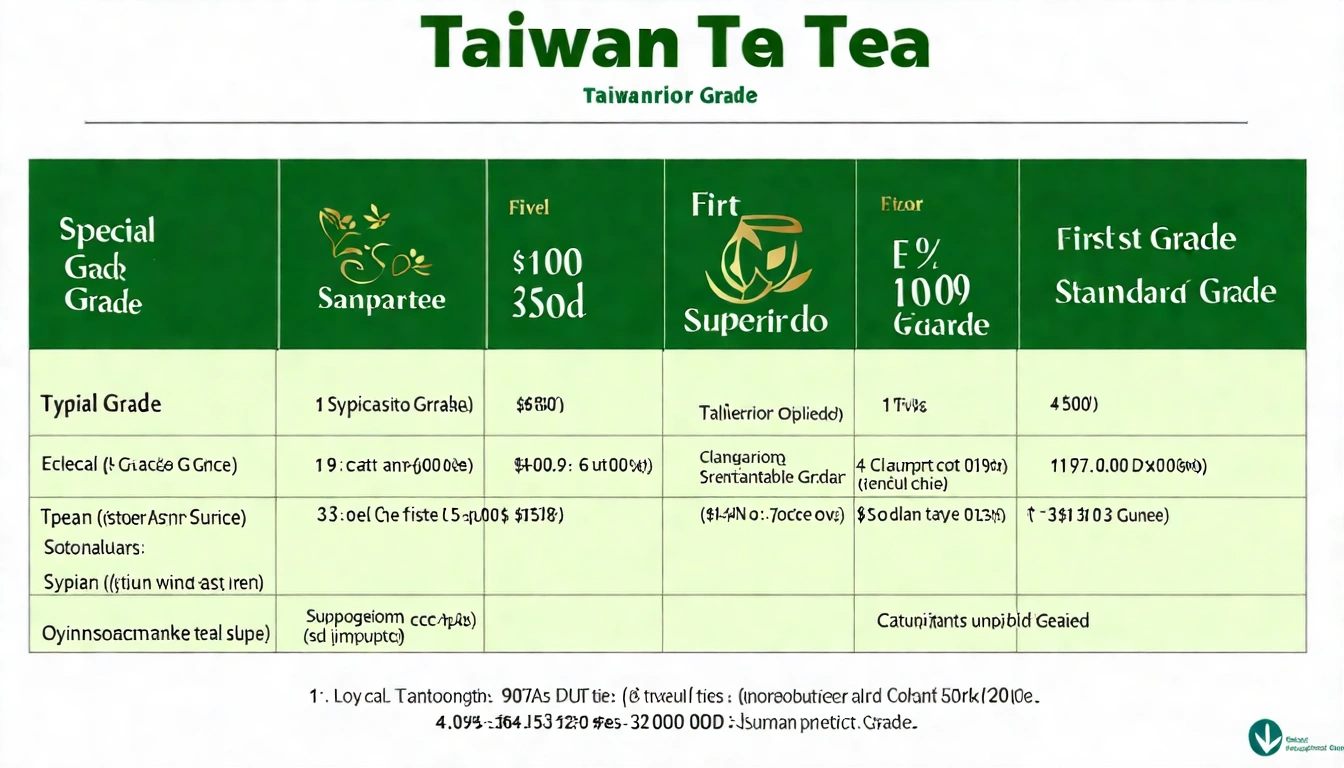
| Grade | Description | Position in Competition | Characteristics | Market Premium |
|---|---|---|---|---|
| Special Grade | Highest honor | Top 1-3 in category | Most refined aroma, most complete flavor | 3-10x normal commercial price |
| First Grade | Second tier | Usually multiple winners | Excellent quality, rich aroma layers | 2-5x normal commercial price |
| Superior Grade | Third tier | Larger proportion | Good quality, stable aroma | 1.5-2.5x normal commercial price |
| Standard Grade | Fourth tier | Broadest | Acceptable quality, everyday level | 1.2-1.5x normal commercial price |
| No Award | Commercial tea | Did not enter or did not place | Quality is NOT necessarily poor — just didn’t compete | Normal commercial price |
Key insight: The gap between Special Grade and First Grade is sometimes far larger than the gap between First Grade and Superior Grade. When buying competition tea, the grade matters, but what matters more is confirming which competition and which year — because the quality of entries varies between competitions.
What Is Competition Tea? Is It Worth Buying?
The nature of competition tea
Competition tea isn’t a “tea variety” — it’s an “identity certification.” It means this batch of tea passed rigorous evaluation by judges in a specific competition.
Competition tea vs. standard commercial tea — practical differences:
| Comparison | Competition Tea | Standard Commercial Tea |
|---|---|---|
| Scarcity | Limited award-winning batches per competition | Mass-produced, stable supply |
| Aroma layers | Typically more refined and complex | Stable, ordinary |
| Traceability | Comes with evaluation number and farmers’ association certification | Sources vary |
| Price | Significantly higher (2-10x) | Normal market price |
| Best for | Important gifts, tea appreciation, collecting | Daily drinking, high-volume use |
When is competition tea worth buying?
- Important gifts (elders, clients, memorable occasions): Competition tea has clear quality endorsement, giving recipients confidence
- Personal tea study: Experiencing Taiwan’s top-tier tea flavors is the fastest way to understand “what makes great tea”
- Tea collectors: Specific years’ Special Grade awards are meaningful collectibles
When you don’t need competition tea:
- Daily high-volume drinking (cost-effectiveness is low)
- Still unsure what tea style you prefer (start with commercial tea)
The first time the ChaYanSo team tasted the Special Grade from the Lugu Township Farmers’ Association Dong Ding Oolong competition, the aroma genuinely made us pause. It wasn’t simply “floral” — it was a complex layering of ripe fruit fragrance with the warmth of roasting, and the lingering sweet aftertaste persisted for 3-5 minutes. That one sip made us truly understand why Special Grade commands its price.
How to Avoid Counterfeit Competition Tea
Competition tea’s high premium also makes it the most commonly counterfeited type of tea on the market.
3 methods to verify authenticity:
- Confirm the award certificate or certification label: Legitimate competition tea comes with a farmers’ association-stamped award label showing batch number, year, and competition name
- Verify with the farmers’ association: Every competition’s results are publicly announced by the farmers’ association — you can look up any batch number to verify whether it genuinely won
- Source transparency: Trustworthy tea merchants will clearly state which competition, which year, and which tea farmer — be cautious of anyone who cannot provide this information
When purchasing competition tea at ChaYanSo, we always personally verify award-winning batches at the farmers’ association and retain complete association-stamped award labels. We’ve had customers bring in “Special Grade” tea purchased online for our assessment, only to discover the batch number was completely unverifiable — this situation is not uncommon on auction platforms. Our advice to consumers: always verify batch numbers with the farmers’ association when buying competition tea. It’s the simplest and most effective anti-counterfeiting method.
How to Read Organic Tea Certifications
Demand for organic tea has increased in recent years, but the certification system can also be confusing for consumers.
Taiwan’s organic tea certification bodies
Taiwan’s primary organic agriculture certification bodies include the Tse-Xin Organic Agriculture Foundation (TOAF), Taiwan Organic Production Association (TOPA), and MOA Taiwan Organic Agriculture Association, among others. The Ministry of Agriculture manages organic certification through the “Agricultural Production and Certification Management Act,” and consumers can verify certified farms through the Ministry of Agriculture website (Source: Ministry of Agriculture, 2024).
| Certification Body | Abbreviation | Focus |
|---|---|---|
| Tse-Xin Organic Agriculture Foundation | TOAF | Most widely recognized organic certification in Taiwan |
| Taiwan Organic Production Association | TOPA | Emphasizes overall farm ecosystem |
| MOA Taiwan Organic Agriculture Association | MOA | Centered on natural farming methods |
| Ministry of Agriculture Certified Bodies | — | Government-designated certification agencies |
Organic tea vs. conventional tea — purchasing considerations:
“Organic” in organic tea refers to the growing process being free of pesticides and chemical fertilizers, but it doesn’t guarantee superior flavor compared to conventional tea. Aroma and taste still depend on variety, origin, and tea-making technique. Organic tea is a “health and safety guarantee,” not a “flavor guarantee” — these serve different purposes. As of the end of 2024, Taiwan’s certified organic area reached 20,304 hectares, with organic tea certification covering approximately 555 hectares. Taiwan tea’s export unit price is approximately 6.5 times that of imported tea, and organic certification makes Taiwan tea even more competitive internationally (Source: Ministry of Agriculture, Organic Agriculture Statistics, 2024).
Want to taste competition-grade Taiwan tea? ChaYanSo has you covered
Grade Selection by Budget
| Budget | Recommended Grade | Suitable Occasions |
|---|---|---|
| NT$300-800 per catty | Standard Grade / non-competition commercial tea | Daily drinking, personal hydration |
| NT$800-2,000 per catty | Superior Grade or equivalent quality | Daily appreciation, casual gifting |
| NT$2,000-5,000 per catty | First Grade | Important gifts, tea enthusiasts |
| NT$5,000+ per catty | Special Grade or limited top selections | High-end gifting, collecting, competition tea enthusiasts |
Taiwan’s competition tea system has a subtle phenomenon: the same “First Grade” from the Lugu Township Farmers’ Association Dong Ding Oolong competition (where competitors include Taiwan’s top tea farmers) versus First Grade from a small local association can differ in actual quality by several times. The truly knowledgeable buying strategy is “check the organizer first, then the grade” — the organizer’s reputation and history is the most reliable guarantee of competition tea quality.
FAQ: Tea Grade Common Questions
Does competition tea always taste better?
Not necessarily, but it’s highly probable. Competition tea has passed rigorous evaluation, typically featuring more refined aroma and richer flavor layers. However, “tastes better” is ultimately subjective — some people prefer light fragrance, others prefer roasted styles. A competition tea’s excellence doesn’t mean everyone will love it. If possible, try before buying, then decide whether to invest in high-priced competition tea.
How can I verify if competition tea is authentic?
Checking the farmers’ association website is the most direct method. After every competition, the association publishes winner lists and batch numbers. If a seller claims to offer competition tea, you can request the batch number and verify it on the corresponding association’s website. “Competition tea” that cannot provide specific batch information should be questioned.
Does organic tea always have low pesticide residue?
Certified organic tea is indeed grown without pesticides or chemical fertilizers, resulting in minimal pesticide residue. But “certified” is key — confirm it’s certified by a Ministry of Agriculture-recognized body (such as TOAF, TOPA, etc.) rather than a product that simply claims to be “organic” without third-party certification.
Further Reading
- Tea Buying Guide for Beginners: From Reading Labels to Choosing Great Tea
- Budget Taiwan Tea Recommendations: Great Tea Under NT$100
- Taiwan High Mountain Tea Complete Guide: Origins, Grades, and Buying Tips
- Alishan Tea Complete Guide: Regional Characteristics and Buying Points
- Beginner Taiwan Tea Recommendations: 5 Favorite Teas for Newcomers
References
- Ministry of Agriculture, Tea Research and Extension Station (2024). Taiwan Tea Evaluation System and Organizing Bodies.
- Ministry of Agriculture (2024). Organic Agriculture Certification Body Directory.