
Taiwan Tea Export Guide 2026 | Japan, USA, and EU Market Entry Requirements and Partnership Models
Taiwan tea’s recognition in international markets has been steadily growing — but “tasting great” is one thing, and “being able to export smoothly” is another.
Each market has different pesticide residue standards, food labeling requirements, and varying degrees of organic certification recognition. If you’re an overseas importer of Taiwan tea, a brand distributor, or looking to promote Taiwan tea in foreign markets, this article compiles the core export information you need to know. ChaYanSo has accumulated extensive experience in export operations, and we share the key practical points below.
According to Taiwan’s Ministry of Agriculture 2024 data, the top three export markets for Taiwan tea are Japan, the United States, and mainland China, which together account for over 65% of total export volume (Ministry of Agriculture, 2024).
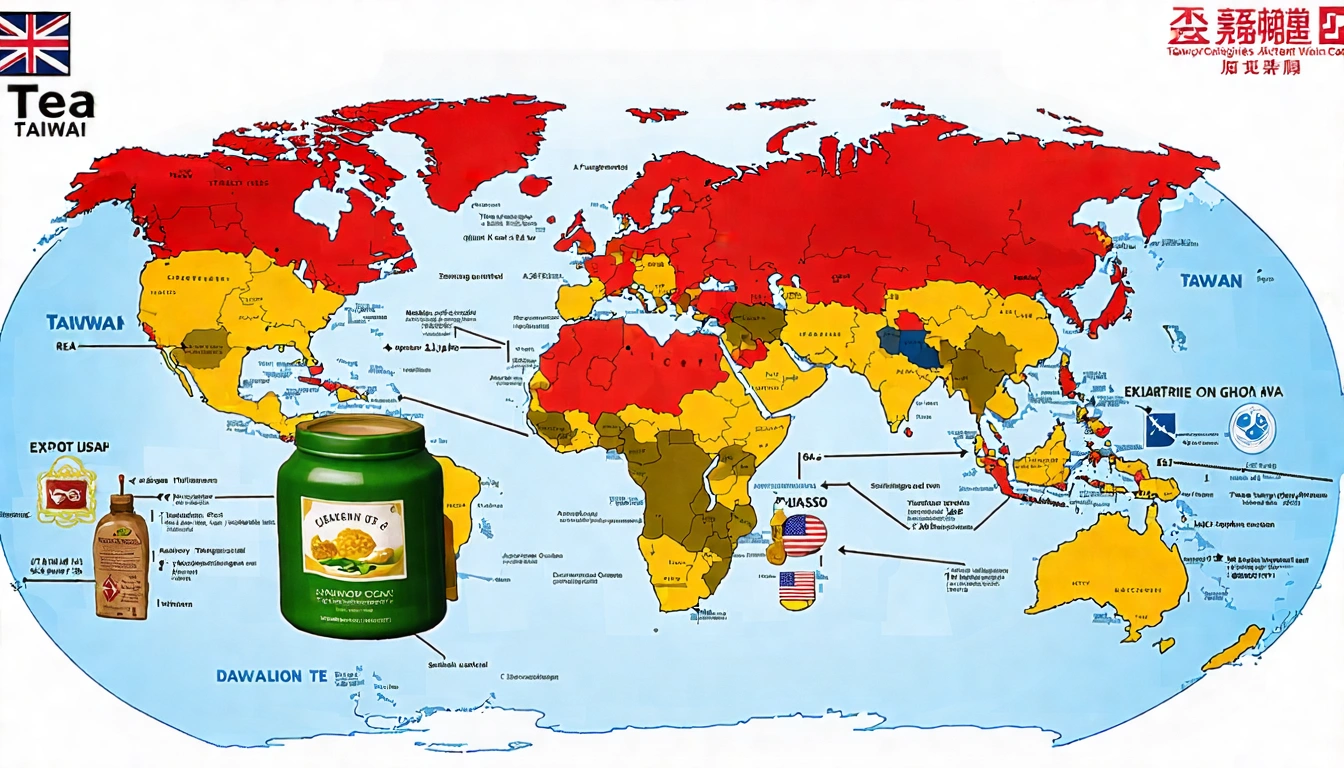
TL;DR: Taiwan tea’s top three export markets: Japan, USA, mainland China (together over 65%) (Ministry of Agriculture, 2024). Each export batch requires a phytosanitary certificate. Japan has the strictest pesticide residue requirements, the US requires FDA registration, and the EU has the highest organic certification requirements. For partnership inquiries, please contact us through our contact page with your requirements.
Have Taiwan tea export or overseas distribution needs? We’re happy to discuss. Export partnership inquiry
Taiwan Tea Export: Basic Documentation Requirements
Regardless of the destination country, the basic export documentation on the Taiwan side is the same:
Phytosanitary Certificate
Before each batch of tea is exported, you must apply to Taiwan’s Ministry of Agriculture Bureau of Animal and Plant Health Inspection and Quarantine for a phytosanitary certificate, confirming the tea is free from pests and diseases (Ministry of Agriculture, 2024). This is a mandatory export document, typically requiring application 1-2 weeks before export, with fees varying by batch size.
Commercial Invoice and Packing List
Standard trade documents recording the exported goods’ product name, quantity, weight, unit price, total value, and other information for customs declaration.
Certificate of Origin
Required by some countries, particularly when utilizing preferential tariff rates under trade agreements between Taiwan and the destination country.
Key Points by Market
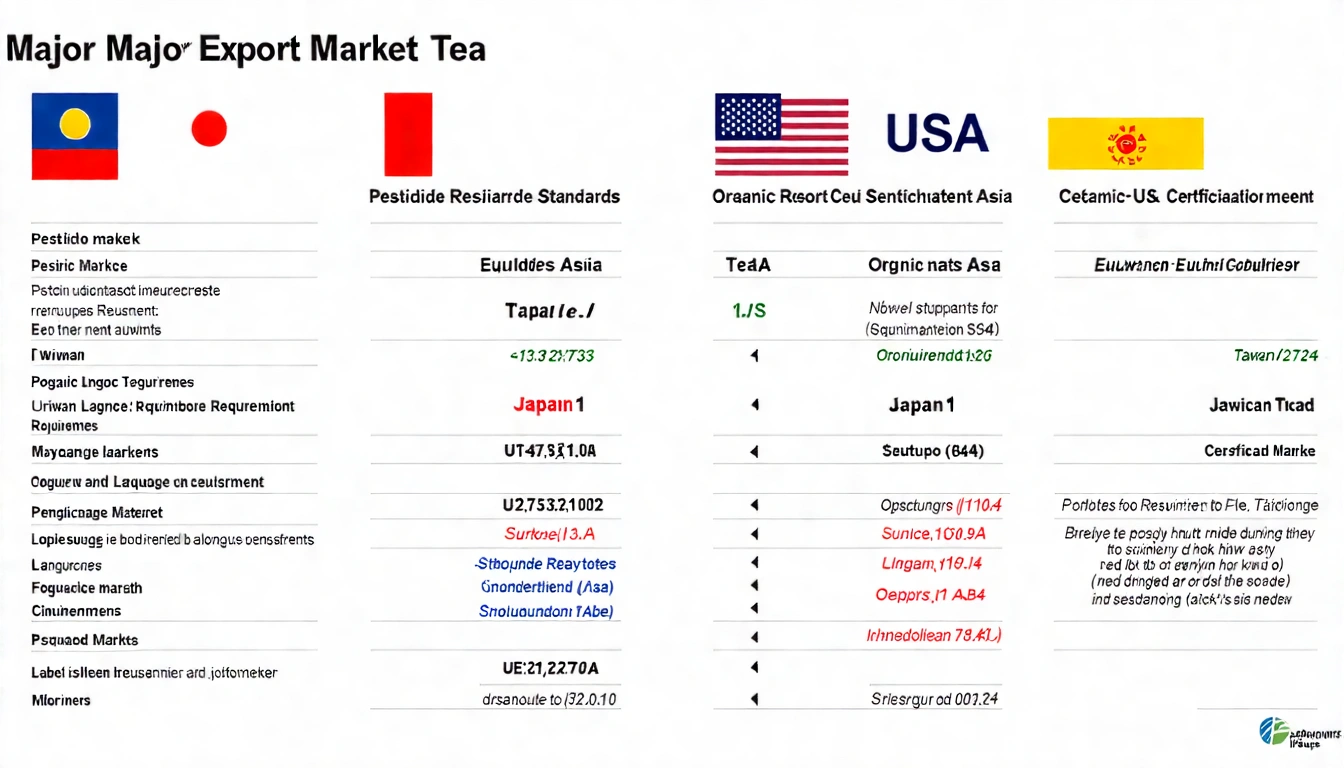
Japan Market
Japan is one of the most important export markets for Taiwan tea, with Alishan oolong tea in particular enjoying high recognition in Japan’s premium tea market.
| Item | Japan Market Requirements |
|---|---|
| Pesticide residue standards | Uses the “uniform standard” (0.01ppm), significantly stricter than Taiwan’s domestic standards |
| Food labeling | Must have Japanese labels indicating product name, ingredients, manufacturer (Taiwan), importer (Japan), etc. |
| Inspection | Japan’s Ministry of Health, Labour and Welfare may conduct pesticide residue spot checks on each batch |
| Consumer preferences | Alishan oolong and Jin Xuan are popular; high packaging quality is expected |
Taiwan tea’s pesticide residue test failure rate in the Japanese market dropped to a historic low in 2023, primarily due to the Taiwan Council of Agriculture’s promotion of stricter origin-level pesticide usage standards (Ministry of Agriculture, 2023). For tea exported to Japan, we recommend selecting source farms with pesticide residue test reports that comply with Japan’s uniform standard.
US Market
The United States is one of the fastest-growing markets for specialty tea, and Taiwan tea’s recognition in premium tea circles continues to rise.
| Item | US Market Requirements |
|---|---|
| Food safety | Must comply with FDA food safety regulations; importers must register with FDA (FSVP requirement) |
| Organic certification | USDA Organic certification is in high demand in the US market |
| Food labeling | English labels per FDA requirements |
| Customs | Food entry documents (Prior Notice) must be submitted to FDA |
| Consumer preferences | Alishan oolong, Oriental Beauty Tea, and Taiwan specialty black teas are gaining attention; teas with stories and geographic indication command premium pricing |
The FDA’s FSVP (Foreign Supplier Verification Program) requires US importers to verify the safety of foreign food suppliers, including confirming that Taiwan tea meets FDA food safety standards (FDA, 2024). ChaYanSo can provide the necessary product information and documentation to support US importers’ FSVP reviews.
EU Market
The EU has the strictest requirements for food safety and organic certification, but it is also one of the markets most willing to pay premium prices for high-quality Taiwan tea.
| Item | EU Market Requirements |
|---|---|
| Pesticide residues | EU MRL standards, with some substance limits stricter than Taiwan’s |
| Organic certification | EU Organic certification or equivalent (Taiwan’s MOA organic certification is not currently automatically recognized as equivalent) |
| Food labeling | Labeled in the importing country’s language; multilingual labels are common |
| Health claims | EU strictly regulates health claims; efficacy claims cannot be freely made on packaging |
EU Organic certification currently does not list Taiwan’s MOA organic certification as equivalent. Exporting to the EU with an organic label requires certification from an EU-recognized third-party certification body (European Food Safety Authority, 2024). This is something Taiwan tea suppliers wanting to enter the EU organic market need to plan for in advance.
Southeast Asian Market
Southeast Asia is an emerging export market for Taiwan tea, with growing Taiwan tea consumer bases in Hong Kong, Singapore, Malaysia, and Thailand.
| Item | Southeast Asian Market Characteristics |
|---|---|
| Primary markets | Singapore, Malaysia, Hong Kong, Thailand |
| Consumer preferences | High mountain oolong and premium Taiwan black teas are popular |
| Import regulations | Vary by country, relatively less strict than Japan/EU, but must be verified individually |
| Market characteristics | Chinese-speaking communities have strong cultural identification with Taiwan tea; premium tea purchasing power is growing |
Among ChaYanSo’s export clients, Japanese market importers have the strictest requirements for product quality consistency — one client accepted 20 consecutive batches of consistent quality before converting to a long-term order, approximately 3-4 times longer than the verification cycle for European and American markets (ChaYanSo, 2025).
Choosing an Overseas Partnership Model
If you want to bring Taiwan tea to overseas markets, there are several different partnership structures:
Model 1: Direct Supply to Overseas Importers
The most common export model. The overseas importer handles local customs clearance, warehousing, and sales; ChaYanSo handles Taiwan-side tea supply, packaging, phytosanitary certificates, and other documentation. Importers can choose to sell under their own brand (OEM) or under the ChaYanSo brand.
Model 2: Regional Distributor Partnership
Finding distributors in specific countries or regions, where the distributor handles local market development and sales, while ChaYanSo provides product support and marketing materials. This model is suitable for partnerships seeking deeper market penetration in specific regions.
Model 3: Direct E-commerce Export
Selling directly to overseas consumers through platforms like Amazon, Rakuten (Japan), Shopee, and others. This model is operated directly by ChaYanSo without requiring overseas partners, but requires handling each market’s tax, logistics, and returns independently.
The most common issue ChaYanSo encounters when working with overseas importers is “differences in how Taiwan tea names are perceived in foreign markets” — “oolong tea” means completely different things in different markets. Japanese consumers are familiar with Taiwan high mountain oolong, while European and American consumers’ impression of “Oolong” is more associated with Chinese products. For export marketing, we recommend emphasizing geographic names like “Alishan” or “Lishan” rather than the generic “Taiwan Oolong Tea” for greater recognition (ChaYanSo, 2025).
For Taiwan tea export partnerships, please share your market and requirements. Export partnership inquiry
FAQ: Common Questions About Taiwan Tea Export
What certifications are needed to export Taiwan tea?
Basic certification: A phytosanitary certificate (issued by the Council of Agriculture before each export batch) is required for all markets. Additional certifications depend on the destination: Japan requires pesticide residue test reports (meeting the uniform standard), the US requires FDA compliance documents (FSVP), and the EU organic market requires EU-recognized organic certification. ChaYanSo can assist with Taiwan-side documentation, while the overseas importer’s qualifications and documents must be handled by the importer.
Are pesticide residues a barrier in overseas markets for Taiwan tea?
Taiwan-grown tea has a pesticide residue compliance rate of 97.2% (Council of Agriculture, 2024), but this is measured against Taiwan’s standards. Exporting to Japan requires meeting the stricter uniform standard (0.01ppm), which some teas may not meet. ChaYanSo’s partner farms maintain complete pesticide usage records, and pre-export pesticide residue test reports (per destination market standards) can be provided to ensure compliance.
What is the minimum export quantity?
There is no regulatory minimum, but considering phytosanitary certificate fees, logistics costs, and packaging costs, exporting less than 10kg is typically not economical. We generally recommend starting initial partnership exports from 20-50kg, depending on the tea variety and packaging format.
Further Reading
- Taiwan Tea Wholesale and B2B Partnership Guide: OEM, Corporate Purchasing, Export
- Hotel and Restaurant Tea Wholesale Guide: Commercial Tea Specifications and Supplier Evaluation
- Taiwan Tea OEM Manufacturing Guide: From Samples to Production
- Taiwan Tea Pesticide Residue Safety Guide: How to Identify Harmful Materials and Pesticide Risks
- Taiwan Tea Knowledge Encyclopedia: Classification, Origins, and Varieties