
How to Tell Real from Fake Taiwan Tea | 2026 Guide to Spotting Foreign Tea Blended as Taiwanese — Traceability QR, Certificate of Origin & Testing Methods
“How can NT$100 foreign tea turn into NT$1,000 Taiwan high mountain tea?”
In June 2026, Taiwan’s PTS aired episode 955 of Independent Special Correspondent, a feature titled “NT$100 foreign tea turned into NT$1,000 high mountain tea.” It exposed how tea-blending fraud keeps surfacing — some operators blend low-priced imported tea and pass it off as high-priced Taiwan high mountain tea to reap illegal profit (PTS Independent Special Correspondent, 2026). For consumers, when the packaging says “Taiwan” and “high mountain” and the tea tastes the part, how are you supposed to tell real from fake?
The good news is that Taiwan has already built an official system to crack down on blending fraud, and consumers have a few simple, practical ways to verify authenticity too. This article lays out the official “three safeguards” and the things you can do yourself, all in one place.
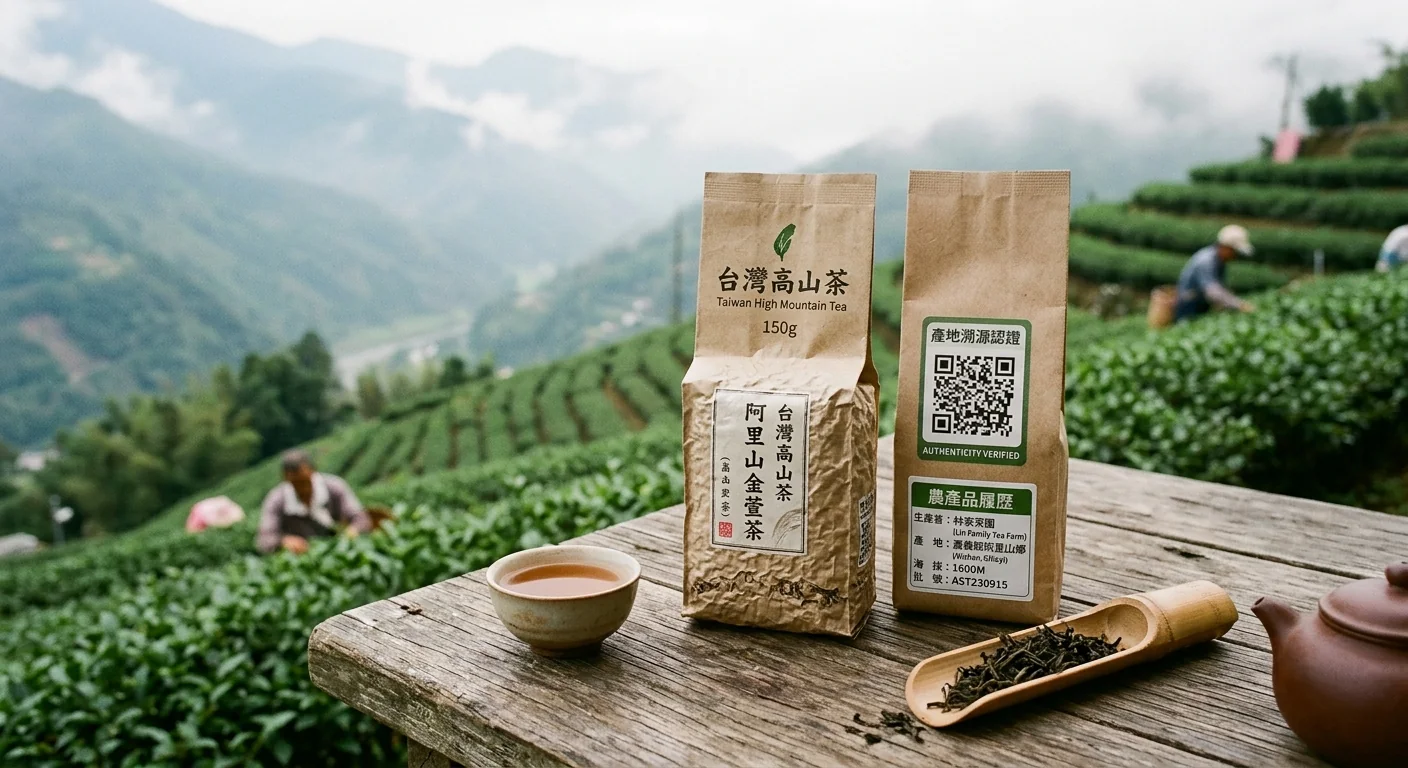
TL;DR: Blending foreign tea into Taiwan high mountain tea is a real problem (PTS Independent Special Correspondent, 2026). Taiwan has three official safeguards — domestic tea has been subject to mandatory traceability since 2023 (one of QR / production-and-marketing record / organic label; AFA), imported tea has required a certificate of origin at customs since July 2020 (Customs Administration), and the Tea Research Station’s “multi-element testing method” can distinguish Taiwan tea from foreign tea (about 98% accuracy; TBRS). The fastest move for consumers is to scan the traceability QR Code on the packaging.
For authentic, traceable Taiwan tea, choose ChaYanSo’s rigorous quality control. Shop tea
Why Does “Foreign Tea Blended as Taiwan Tea” Happen?
The root motive is simple: the profit from the price gap.
There’s a huge price gap between cheap imported foreign tea and expensive Taiwan high mountain tea. By blending cheap imported tea, relabeling it, and passing it off as Taiwan high mountain tea, sellers can move a very-low-cost product at a very high price — exactly the “NT$100 foreign tea turned into NT$1,000 high mountain tea” phenomenon PTS exposed in episode 955 (PTS Independent Special Correspondent, 2026).
A second, structural reason is the supply–demand gap. Taiwan’s domestic tea output is far lower than the country’s tea consumption, leaving plenty of room in the market that imported tea fills. When imported and domestic tea get mixed together in loose, unlabeled form, the room for blending fraud grows even larger. In other words, the tea that’s genuinely prone to problems isn’t the properly labeled, traceable Taiwan brand tea — it’s the loose tea of unknown origin that can’t be traced.
That’s exactly why “can the source be verified?” becomes the core of telling real from fake Taiwan tea.
Taiwan’s Three Official “Anti-Blending” Mechanisms
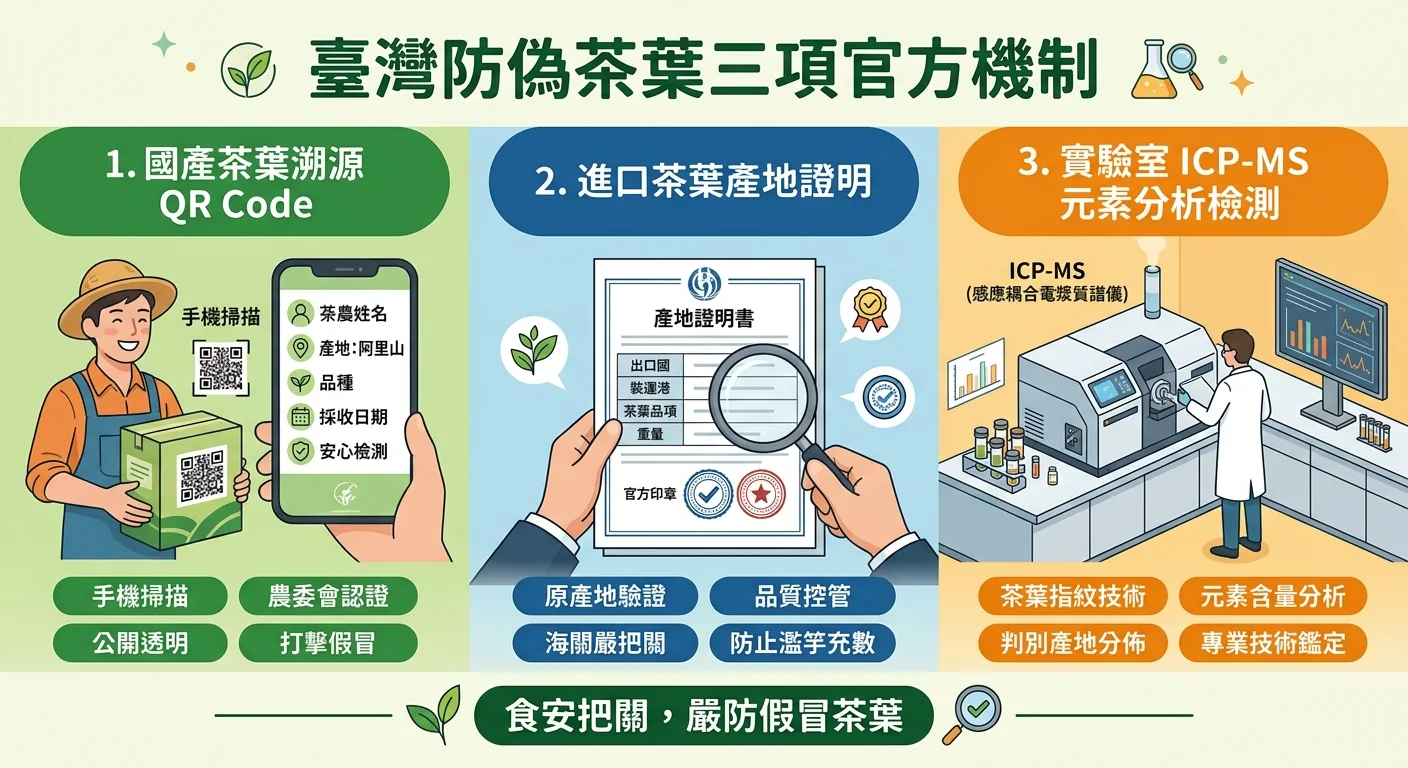
To tackle the blending problem, Taiwan has built three official mechanisms that form a chain of defense across production, import, and enforcement.
First: mandatory traceability for domestic tea (production end)
Since January 1, 2023, domestic tea labeled as originating from “Taiwan” has been required to provide one of the following: an agricultural-and-food traceability barcode (QR Code), a production-and-marketing record (TGAP), or an organic label (Agriculture and Food Agency, AFA). This means properly produced Taiwan domestic tea should carry at least one verifiable traceability marking on the package — scan the QR Code and you can trace the producer and origin of that batch.
Second: certificate of origin for imported tea (import end)
Since July 1, 2020, imported tea, under import regulation code “465,” must be accompanied by a certificate of origin issued by the government of the exporting/producing country or an authorized body in order to clear customs (Customs Administration, Ministry of Finance). In other words, legally imported foreign tea is required at customs to make clear “where this batch of tea came from,” establishing an origin record for imported tea from the source.
Third: the Tea Research Station’s multi-element testing method (enforcement end)
The Tea and Beverage Research Station (TBRS) under the Ministry of Agriculture established a “multi-element testing method for tea,” published as a recommended testing method (number TFDAF0032.00) in November 2021. The method uses inductively coupled plasma mass spectrometry (ICP-MS) to analyze the trace-element profile of tea, distinguishing Taiwan tea from foreign tea with about 98% accuracy. It applies to small-leaf varieties such as Qingxin Oolong, TTES No. 12, and Sijichun, and is mainly used to investigate cases of foreign tea blended as Taiwan tea (Tea and Beverage Research Station, Ministry of Agriculture).
| Safeguard | Authority | In effect | Function |
|---|---|---|---|
| Mandatory domestic-tea traceability | Agriculture and Food Agency (AFA) | Jan 2023 | One of QR / production-and-marketing record / organic label; traces producer and origin |
| Imported-tea certificate of origin | Customs Administration, MOF | Jul 2020 | Certificate of origin from exporting country required at customs |
| Multi-element testing method | Tea Research Station (TBRS) | Published 2021 | ICP-MS trace-element profiling to distinguish Taiwan vs foreign tea (about 98% accuracy) |
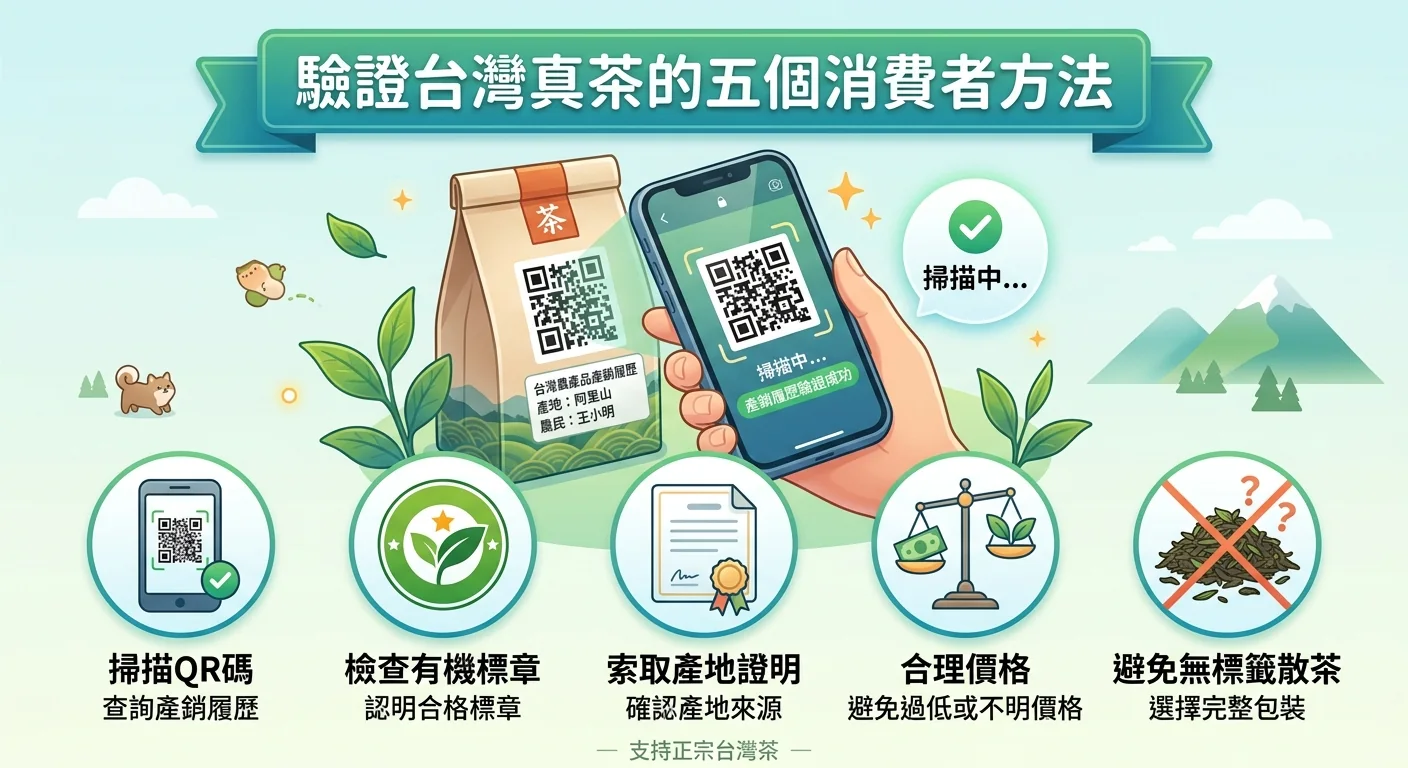
How Can Consumers Verify Real vs Fake Taiwan Tea? 5 Practical Methods
The official mechanisms are the defense line, but consumers can also take a few simple steps at the point of purchase to greatly reduce the chance of buying blended tea.
Method 1: Scan the traceability QR Code, look for the production-and-marketing record label
This is the most direct method. Since 2023, domestic tea labeled as originating from “Taiwan” must provide one of three things: an agricultural-and-food traceability barcode (QR Code), a production-and-marketing record, or an organic label (Agriculture and Food Agency). When you see a traceability QR Code on the package, a quick scan lets you trace the producer and origin of that batch.
Method 2: Look for the organic label
The organic label is one of the three traceability options for domestic tea. Organically certified tea can likewise be traced to a specific farm and its certification details — another “verifiable” form of assurance.
Method 3: Ask for the imported tea’s certificate of origin
If you’re buying imported tea, legally imported foreign tea has already been required to provide a certificate of origin at customs (Customs Administration). Confirming the origin with the seller and asking them to explain the source is a reasonable question that should be answered.
Method 4: Watch for a reasonable price range
Profit from the price gap is exactly what drives blending fraud. When a tea claimed to be Taiwan high mountain tea is priced clearly below the reasonable range for comparable, properly sourced products on the market, it’s worth asking one more question: “Where does this batch come from, and can it be traced?” Price alone isn’t the only criterion, but an abnormally low price is often a warning sign.
Method 5: Avoid unlabeled loose tea
Blending is easiest to pull off with unlabeled, untraceable loose tea. Loose tea with no origin, no traceability QR, and no clear explanation of its source carries the highest risk. Prefer packaged tea that is fully labeled and can be traced by scanning.
Competition Tea and Origin Labels: Verifiable Assurance
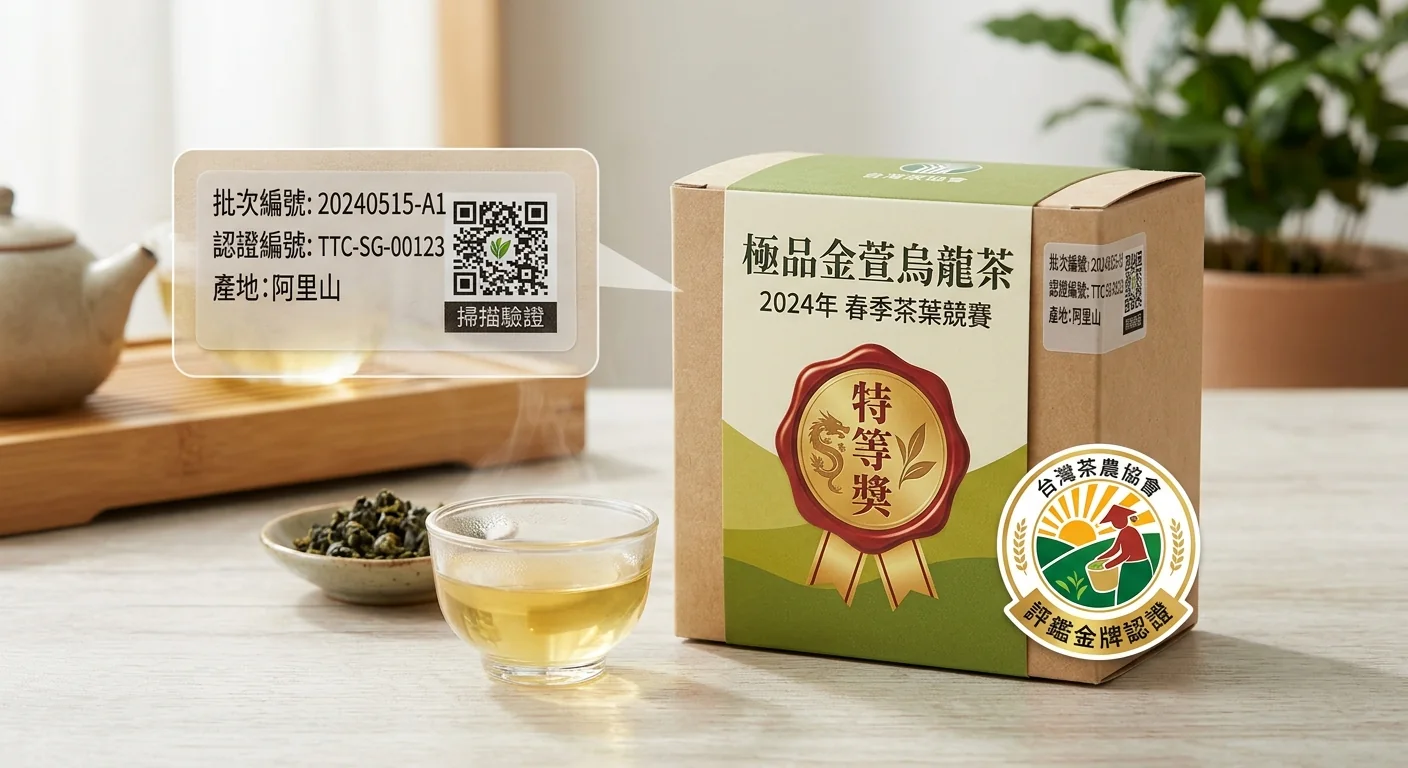
Beyond the official traceability mechanisms, competition tea is another verifiable source of assurance.
In tea competitions held by local farmers’ associations, winning teas come with a batch number, and consumers can usually verify the award record on the farmers’-association website using that batch number. This “verifiable batch number” mechanism shares the same spirit as the domestic-tea traceability QR — the point in both cases is that this batch of tea can be traced and verified.
In other words, whether it’s a traceability QR, an organic label, or a competition tea’s batch number, what really lets you buy with confidence isn’t the pretty wording printed on the package, but whether there’s a source record behind that batch that you can actually look up.
Common Myths
Myth 1: “Higher price always means more genuine?”
Not necessarily. The profit from the price gap is the motive for blending, so a high-price label alone can’t guarantee a tea’s true origin. What really proves origin is a verifiable traceability record — domestic tea’s traceability QR, production-and-marketing record, or organic label (Agriculture and Food Agency). Rather than looking only at price, look at whether the batch can be traced.
Myth 2: ""Taiwan” printed on the package guarantees it’s produced in Taiwan?”
You can’t go by the wording alone. While, since 2023, domestic tea labeled as originating from “Taiwan” must provide one of a traceability QR, production-and-marketing record, or organic label (Agriculture and Food Agency), consumers should still actually scan the code or verify the label rather than relax just because they see the word “Taiwan.” If a package carries no verifiable traceability marking at all, that’s all the more reason to stay alert. Imported tea, meanwhile, is subject to the separate certificate-of-origin requirement at customs (Customs Administration).
FAQ: Common Questions About Real vs Fake Taiwan Tea
How do I check whether a pack of tea is produced in Taiwan?
Look for verifiable traceability information on the package. Since 2023, domestic tea labeled as originating from “Taiwan” must provide one of an agricultural-and-food traceability barcode (QR Code), a production-and-marketing record, or an organic label (Agriculture and Food Agency); scan the code to trace the producer and origin. If it’s imported tea, a certificate of origin was already required when it was legally imported (Customs Administration). Loose tea with no traceability marking at all is the hardest to verify and carries the highest risk.
Is imported tea always worse?
No. The problem isn’t “imported” itself, but “blending fraud” — passing off low-priced imported tea as high-priced Taiwan high mountain tea for illegal profit (PTS Independent Special Correspondent, 2026). Legally imported foreign tea has already been required to carry a certificate of origin at customs (Customs Administration); as long as the origin is clearly labeled and it’s sold honestly, imported tea itself is fine. What you should avoid is tea of unknown origin that’s been relabeled to impersonate something else.
Is tea without a traceability QR fake?
Not necessarily, but be more careful. Domestic tea has three traceability options (QR Code, production-and-marketing record, organic label), and any one of them is enough (Agriculture and Food Agency), so the absence of a QR doesn’t automatically mean a problem — it may use a production-and-marketing record or an organic label instead. The key is that the package should carry at least one verifiable traceability basis; if it has none of the three and the source can’t be explained, the risk is clearly higher.
Further Reading
- Tea Pesticide Residue 2026 Complete Guide: How to Buy Safe Taiwan Tea
- Tea Grades & Competition Tea Complete Guide
- Taiwan High Mountain Tea Complete Guide: Regions, Features & Buying Tips
- Alishan Tea Complete Guide: Region, Flavor & Buying Tips
References
- PTS Independent Special Correspondent Episode 955 (June 3, 2026). NT$100 foreign tea turned into NT$1,000 high mountain tea. https://www.youtube.com/watch?v=CQOaJ_j67ok
- Agriculture and Food Agency, Ministry of Agriculture. Domestic tea traceability labeling rule (effective January 1, 2023). https://www.afa.gov.tw/cht/index.php?code=list&flag=detail&ids=307&article_id=25138
- Customs Administration, Ministry of Finance. Imported tea import regulation “465” certificate of origin (effective July 1, 2020). https://www.mof.gov.tw/singlehtml/384fb3077bb349ea973e7fc6f13b6974?cntId=bd340c0d6c5e4c2b87d886d285c16a9b
- Tea and Beverage Research Station, Ministry of Agriculture (2021). Multi-element testing method for tea (TFDAF0032.00). https://www.tbrs.gov.tw/theme_data.php?theme=news&sub_theme=agricultural_news&id=4843