
Loose Leaf Tea vs Tea Bags 2026 | Which Tastes Better? Quality, Convenience & Price Compared
“Loose leaf tea tastes better than tea bags” — this statement has circulated in Taiwan’s tea world for years, but is it still true or has it become outdated?
A few years ago, “tea bags” practically meant “broken tea dust stuffed in a paper pouch,” and the quality gap with whole-leaf loose tea was indeed significant. But Taiwan’s tea bag market has evolved dramatically: whole-leaf pyramid tea bags (also called 3D tea bags) use complete tea leaves with ample room to unfurl, reaching quality levels very close to loose leaf.
This article uses data and real comparisons to help you understand the actual differences between loose leaf and tea bags in 2026, and which to choose for each scenario.
TL;DR
Loose leaf has a slight quality edge (complete leaves, richer aroma) but requires proper tea ware. Whole-leaf pyramid tea bags now achieve 80-90% of loose leaf quality, with far superior convenience. By equal weight, loose tea’s 5-8 re-steepings make it 40-60% cheaper per cup than tea bags. The key: choose loose leaf for home tea sessions; choose whole-leaf tea bags for office/travel/gifting. Each has its ideal scenario — there’s no absolute “better or worse.”
Loose Leaf vs Tea Bags: One Table to Understand the Core Differences
According to market research, approximately 60% of global tea consumers prefer tea bags, mainly for convenience and portion control (Tea Infusiast, 2025). But in Taiwan, where oolong tea (semi-oxidized tea) dominates production (Ministry of Agriculture) and loose leaf culture runs deep, the choice between loose leaf and tea bags deserves closer examination. Here’s the most important comparison:
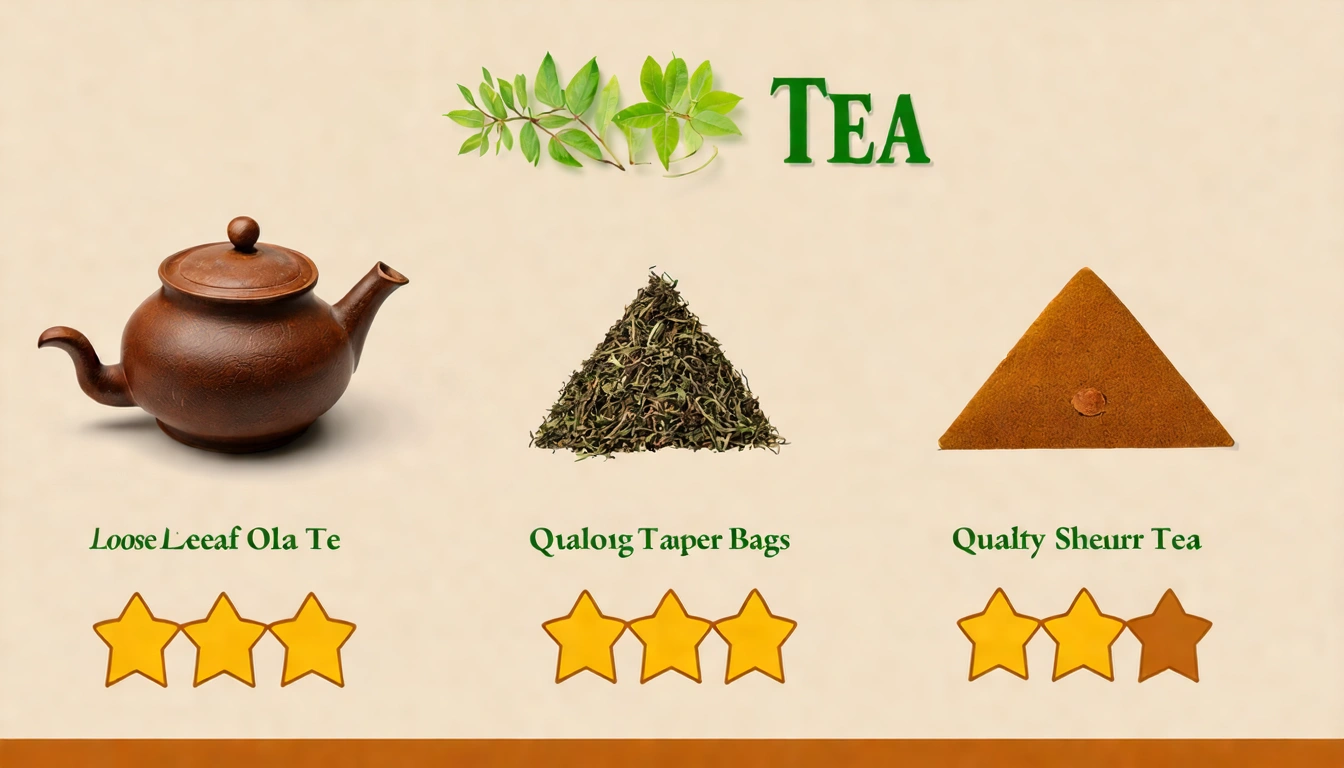
| Comparison | Loose Leaf | Whole-Leaf Pyramid Bag | Broken-Leaf Flat Bag |
|---|---|---|---|
| Quality/Flavor | Best | Close to loose leaf | Noticeably inferior |
| Convenience | Needs tea ware | Instant brew | Instant brew |
| Re-steeping | 5-8 times | 2-3 times | 1 time only |
| Storage difficulty | Needs sealed container, light-protected | Individual packs easier | Individual packs easier |
| Cost per cup | Lowest (high re-steepability) | Medium (good value) | Lower (but poor quality) |
| Portability | Not convenient | Lightweight, portable | Lightweight, portable |
| Gifting suitability | Packaging challenging | Gift boxes available | Not suitable for gifting |
Quick conclusions:
- Home tea sessions, pursuing highest quality — Loose leaf
- Office, travel, convenient daily drinking — Whole-leaf pyramid tea bags
- Large-volume low-cost hydration — Broken-leaf tea bags (but consider upgrading to whole-leaf)
Quality Comparison: Does Loose Leaf Really Taste Better?
Taiwan’s tea growing area covers approximately 12,000 hectares with annual production of about 14,000 metric tons (Ministry of Agriculture TRES, 2022). The quality gap between loose leaf and tea bags depends on the type of tea bag, not simply “loose leaf always wins.” The answer is: it depends on which kind of tea bag.
Loose Leaf Quality Advantages
Complete-leaf loose tea has three quality advantages:
- More room to unfurl: Loose leaf in a pot or gaiwan can fully expand, allowing essential oils and aromatic compounds to release completely
- Richer aroma complexity: Complete leaves retain more volatile aromatic substances
- Greater re-steepability: Can be infused 5-8 times, with aroma and flavor shifting slightly each round — this is the joy of the tea-drinking experience
But loose leaf also has drawbacks: requires tea ware (teapot/gaiwan, strainer, cups), more involved brewing process, and impractical for travel.
Whole-Leaf Pyramid Tea Bags: Very Close to the Loose Leaf Experience
This is the most important quality upgrade in Taiwan’s tea bag market of the 2020s: nylon or PLA pyramid tea bags provide sufficient 3D space for complete leaves to unfurl, dramatically narrowing the gap with loose leaf. At ChaYanSo, when developing our whole-leaf tea bags, we repeatedly compared pyramid bags against the same batch of loose leaf. Our conclusion: good whole-leaf tea in a pyramid bag with adequate space can reproduce over 80% of loose leaf’s aroma complexity — a result that gave us strong confidence in tea bag quality.
Comparing the same grade of Alishan oolong: loose leaf’s aroma complexity and depth are indeed slightly superior, but whole-leaf pyramid bags can present 80-90% of the tea’s core flavor characteristics. For daily drinking rather than professional evaluation, this gap is not significant in practice.
Broken-Leaf Flat Tea Bags: The Quality Gap Is Real
Traditional broken-leaf flat tea bags (the kind commonly found in supermarkets) are where the real quality gap with loose leaf lies: broken tea extracts quickly, is highly bitter, can only be brewed once, and the aroma is virtually flat.
Conclusion: When people say “tea bags are worse than loose leaf,” they usually mean this type of broken-leaf flat bag, not whole-leaf pyramid bags.
For more on how tea bag materials affect quality, see Tea Bag Material Safety Guide: How to Identify Harmful Plastics.
Convenience Comparison: Which Makes Tea-Drinking Easier?
According to a Pollster online survey, over 92% of Taiwan’s consumers say they drink tea from tea bags, with “convenience” as the primary selection factor (Pollster, 2019). The workflow differences between loose leaf and tea bags directly determine which life scenarios they’re suited for.
Loose Leaf Brewing Process
- Prepare tea ware (teapot or gaiwan, strainer, fairness pitcher, cups)
- Measure the right amount of tea leaves (3-5g)
- Warm the vessel, add tea
- Brew with properly tempered water, time it
- Pour into fairness pitcher, distribute
- Clean the tea ware after drinking
The entire process takes 5-10 minutes, including cleanup. For those who enjoy the ritual of tea, it’s a pleasure; for those who just want a quick drink, it’s a burden.
Tea Bag Brewing Process
- Tear open the packet
- Place in cup
- Brew with hot water for 2-3 minutes
- Remove and discard tea bag
- Drink
Done in under a minute.
Convenience Analysis by Life Scenario
| Scenario | Loose Leaf | Whole-Leaf Tea Bag |
|---|---|---|
| Home, slow-brew tea session | Best choice | Acceptable |
| Office quick brew | Impractical | Best choice |
| Travel | Too heavy, too complicated | Light and perfect |
| Afternoon tea break | Ritual enjoyment | More convenient |
| Gift for a non-tea-drinker friend | They won’t know how to brew it | Tear open and brew |
For detailed office tea recommendations, see Office Tea Bag Recommendations: Best Taiwan Whole-Leaf Tea Bags for Professionals.
Price Comparison: Loose Leaf vs Tea Bags — Which Is More Economical?
Taiwan tea’s export unit price is approximately 6.5 times that of imported tea (Ministry of Agriculture), reflecting Taiwan tea’s premium quality positioning. Within this price range, the cost structure differences between loose leaf and tea bags are worth calculating carefully. This comparison only works if you calculate correctly — you can’t just compare “how much you spend at once.”
Calculated by Cost Per Cup
Using the same Alishan oolong as an example:
Loose leaf (NT$400-800 per 100g):
- Tea per brew: approximately 3-5g
- 100g yields: 20-33 brews
- Infusions per brew: 5-8
- Total cups: 100-264
- Cost per cup: approximately NT$1.5-8
Whole-leaf pyramid tea bags (NT$150-300 per 10 bags):
- Brews per bag: 2-3
- 10 bags total cups: 20-30
- Cost per cup: approximately NT$5-15
Conclusion: By cost per cup, loose leaf is 40-60% cheaper than equivalent-quality tea bags. But loose leaf requires a higher initial investment (tea ware) and more brewing time.
Whole-Leaf Tea Bags’ Value Is in the “Convenience Premium”
Paying 50-100% more for whole-leaf tea bags over loose leaf, what you’re actually buying is:
- No tea ware needed
- 5x or more time savings
- Feasibility for travel/office scenarios
If you drink tea 2-3 times a day across various scenarios, having both is the ideal strategy.
Loose leaf and whole-leaf tea bags — ChaYanSo curates both from Taiwan high mountain origins, with quality guaranteed. Browse Our Teas
How to Choose: Let Your Lifestyle Decide
The global tea market reached approximately US$69.5 billion in 2025 (Grand View Research), with loose leaf and tea bags each occupying different consumption scenarios. The key to choosing isn’t quality superiority — it’s your lifestyle. At ChaYanSo, we’ve worked with many customers and found that most end up with a “loose leaf at home, tea bags on the go” dual-track approach — you don’t have to choose one or the other.
Choose Loose Leaf If You…
- Have complete tea ware (teapot or gaiwan)
- Have sufficient tea-brewing time at home
- Are genuinely interested in the tea-tasting experience (brewing is a pleasure, not a chore)
- Drink tea frequently and want to minimize per-cup cost
- Want to explore the depth of Taiwan tea’s flavor profiles
Choose Whole-Leaf Tea Bags If You…
- Primarily need tea at the office, outdoors, or while traveling
- Don’t have tea ware or don’t want to clean tea ware
- Want to give a non-tea-drinking friend or family member an accessible “introduction to great Taiwan tea”
- Need something for gifting or as a souvenir
- Want to try multiple tea varieties without stocking loose leaf for each (tea bags make variety easy)
Best Strategy: Have Both
Honestly, this isn’t an either/or choice. Many tea drinkers’ habit is: slow-brew loose leaf at home, carry a few whole-leaf tea bags when going out. This way you enjoy the home tea ritual while never missing out on good tea outside.
FAQ
Q: Does loose leaf always taste better than tea bags?
Not necessarily. Loose leaf tastes better than broken-leaf flat tea bags — that’s true. But the gap with whole-leaf pyramid tea bags has narrowed dramatically. Same-grade whole-leaf tea bags can present 80-90% of loose leaf’s core flavor. If you’re comparing against supermarket broken-leaf tea bags, loose leaf is clearly superior. If comparing against whole-leaf pyramid bags, the main differences are in aroma complexity and re-steeping count — not significant for daily drinking.
Q: Can whole-leaf tea bags really taste as good as loose leaf?
They come very close. Whole-leaf pyramid tea bags in ample hot water (use a large cup or pot, not a small cup) achieve unfurling effects approaching loose leaf. The main gap: pyramid bags still have physical space limitations, so the very highest aroma layer is slightly less than fully freely-unfurled loose leaf. But for the vast majority of daily drinking, whole-leaf pyramid tea bags are already excellent.
Q: How should loose leaf tea be stored?
Store loose leaf in a sealed container (tin or ceramic jar is best), in a cool, dark place away from kitchen oil fumes and moisture. Refrigerator storage is not recommended — Taiwan household refrigerators tend to cause tea to absorb odors. Well-sealed loose leaf stored at room temperature in a cool environment keeps for 6 months to 1 year; well-sealed high mountain tea can last 18 months or more.
Finding Your Tea-Drinking Rhythm with Loose Leaf and Tea Bags
Taiwan’s hand-shake tea market exceeded NT$133.1 billion in 2024 revenue (Ministry of Economic Affairs Statistics), but more consumers are returning to the joy of brewing their own tea. The loose leaf vs tea bag debate actually asks the wrong question. What really matters is: in what scenario, with what mindset, are you drinking tea? At ChaYanSo, our deepest insight over the years is that “good tea” is defined differently by everyone — finding a tea-drinking rhythm that suits your life matters more than chasing “the best format.”
At home with time and tea ware, loose leaf gives you a more complete tea experience. On the go or at the office, whole-leaf pyramid tea bags let you enjoy great Taiwan tea anywhere. Both choices are right — the only difference is your life’s rhythm.
For more complete Taiwan tea bag recommendations, see Taiwan Tea Bag Recommendations: Top 5 Categories of Whole-Leaf Tea Bags Worth Buying in 2026.
Find your tea-drinking rhythm. Let ChaYanSo be with you every day. Loose leaf and whole-leaf tea bags — ChaYanSo curates from Taiwan origins, quality guaranteed.
Further Reading
- Gift-Worthy Taiwan Tea Bag Gift Box Recommendations: Heartfelt Tea Gifts
- Travel Tea Bag Recommendations: Lightweight, Sealed & Bringing Taiwan Flavor Worldwide
- Cold Brew Tea Bag Recommendations & Complete Guide: Essential Summer Cold Brew Tips
References
- Ministry of Agriculture TRES - Taiwan Tea Quality Research and Brewing Guide
- Ministry of Agriculture - Taiwan Tea Production Status and Promotion Measures
- Taiwan Tea Bag Technology Development Report - Whole-Leaf Pyramid Tea Bag Quality Research
- Major Taiwan tea brand loose leaf brewing recommendations
- Tea Infusiast - How Popular Are Tea Bags? - Global tea bag consumer preference statistics
- Pollster Online Survey - Tea Bag Drinking Habits Survey
- Ministry of Economic Affairs Statistics - Industry Economic Statistics